Showing posts with label composition. Show all posts

Wednesday, December 21, 2016

Hervararkviða, or the Incantation of Hervor

Sea Tangle: Songs from the North

You might find this difficult to believe, but I am primarily a composer and not an amateur historian or archaeologist or theater builder/owner or whatever. To prove it, this year I wrote some music? Actually quite a lot of music, if I put it all together, although I am still way behind in my goals, because I will never be good enough and yes I do hate myself for it although I am trying to work on unrealistic expectations of myself in therapy thank you.

One of these pieces is being officially birthed into the world today (that is, Wednesday, December 21, 2016)! And if you are in the Philadelphia area, you are welcome to come witness its emergence in person, which will be beautiful and non-bloody and not at all like a real human birth. This piece was conceived way back in January, when I was approached by dreamy mezzo-soprano Maren Montalbano, she of the gorgeous silver curls and even prettier velvety silver voice, whom I knew through her work at Opera Philadelphia (we performed together in ANDY: A Popera),  Choral Arts Philadelphia (I wrote O Oriens for them last Christmas), and Twitter.

Monday, February 22, 2016

The Lola Ridge songs, in one convenient blog post

Three generations of women composers at the Volti Choral Institute: me (duh), high school senior Morgan Orsolini, whose choral work Awaken Again was among those performed, and the incomparable composer/pianist/conductor Sue Bohlin

A few weeks ago, I returned to frigid Philadelphia from California and immediately came down with a nasty case of the flu. My bad for procrastinating getting a flu shot this year until I forgot about it, but I'm also feeling some animosity toward the lady who open-mouth-coughed on me at the Saint Louis Airport on the trip home. I'm sure it was her. 

Then my cat Tripoli passed away last week. She was about 14 and it was her time to go, but both Matt and I are still a bit choked-up over it.

It's time to get back on the horse, though, especially since I am in happy possession of the results of my California trip: live recordings of all of my Lola Ridge songs.

Thursday, January 21, 2016

Six month catch-up

It's funny how the mind works in relation to reality. I've been avoiding writing a blog entry because I honestly thought I wouldn't have anything to report. But as I sat down today and forced myself to start looking back through my calendar and photos from the last six months, the evidence suggested otherwise.

I'll talk about what's happened in non-Hannah-related life first, and then write a separate entry explaining where we're at with the theater tomorrow. Spoiler: despite some effort, there has been little material progress, which is one disappointing reason it feels like I've done nothing at all. Also, I haven't finished my opera. And it's the middle of winter. And I'm processing some childhood emotional garbage and familial grief which I'm not going to go into, but which is seriously harshing any buzz I might have the energy left to muster.

But enough whining. In the last six months, I:

Thursday, July 17, 2014

A sampling of work from the O'Neill: Red Fox / White Fox

I am pleased to report that thanks to all that blathering in my last blog post, more than one choir director has expressed an interest in programming It's strange about stars... at some point in the future, so I am hopeful that, even if I don't have any luck with the Twin Cities Women's Chorus competition, it will get a premiere some day soon. This is good, because I would be disappointed if something I've written that I actually like was left by the wayside.

Also: by request, I have arranged it as a viola quartet, for those of you out there lucky enough to know four or more violists: download the score and parts here. I suppooooose theoretically you could also play it with up to three violin parts, but where's the fun in that.

While I'm in a sharing mood, I figure I should give you a taste of some of the musical products of the O'Neill 2014 National Puppetry Conference last month. The following tracks were created for the amazing and mesmerizing and extremely crush-worthy duo Red Fox / White Fox, aka Jordan Morley and Lisi Stoessel. Here they are performing their participant piece with live music created during improvisations in rehearsals with the very talented Diana Sussman (here on melodica):


Red Fox | White Fox @ the O'Neill Puppetry Conference 2014 from Jordan Morley on Vimeo.


Sunday, July 13, 2014

L-O-L-A Lola la-la-la-la Lola; or What is my culture?

I started writing this post at the Eugene O'Neill Theater Center in Connecticut last month, where I was the very happy music composition director for the 2014 National Puppetry Conference, surrounded by dozens of deliciously creative and crafty people. For eight days, I found myself with more energy and confidence than I had felt in a very long time — a common effect of the O'Neill — although that boost might also have been left over from a sudden storm of inspiration and discovery I had a few days before I left Philly, after months of compositional drought.


Performing (on my new Luis & Clark viola) at the O'Neill showcase. Photo by Richard Termine.

Frustrated with Ayn that week, I decided I might as well set myself a short composition exercise to help open the sluices, the sort of thing I used to do back when I was in coursework. The task: to write a short and relatively easy work for SSAA chorus in response to a competition call from the Twin Cities Women's Choir. The deadline: three days. Step one: find a decent text.

Thursday, July 10, 2014

Happy birthday, Mr. Tesla

It's Nikola Tesla's 158th birthday! Along with all the other celebrations and million-dollar donations to museums in his honor, what better day to post the audio and photos from the performance of Tesla's Pigeon by the Secret Opera in New York City recently:

Tesla's Pigeon was sung in this performance by soprano Chelsea Feltman, accompanied by Joseph Yungen. Photos here are by Amanda Aulicino:

Tuesday, April 29, 2014

The worst part of composing

Everyone has their own damn hell to push through, but here's mine: after months, nay, years, of feeling creatively kind of constipated (refer to multiple posts about depression on this very blog), I go back to a theme I smeared on the page maybe a year ago, and I hate it. It's supposed to be a twisted love theme. It's shit. It's a turd that I have tried multiple times to polish, but all it does is smear into ever more bland and messy stains. I decide to scrap the entire theme and do the whole damn thing over, which is going to affect a bunch of other moments and scenes, but whatever; they're all shit, contaminated by the stink of this stupid theme. They all need to be rewritten. In fact, most of the scenes in question need to be written, never mind the re-, so who cares; I may as well start over. After hours of staring at the newly blank staves while too afraid to move, I finally write a different theme. I think it's better, but I'm not sure. I worry that I'm second guessing this brand new theme. But then, I was second guessing myself by scrapping and rewriting the original theme, so actually, this is at least the third guess. I'm starting to think everything is a damn guess, and none of the guesses are close to the mark.

Sometimes I really wish I could trust myself. But if I do, and the result is a giant smear of excrement, well, that won't do at all, will it?

In conclusion, I hate everything.

Wednesday, June 19, 2013

Link to composition news! Plus ... more avian Ink...?

I just sent out another edition of my e-mail blast, which has lots of lovely news in it, particularly recording news. You can read it here (and by the way, for the moment, you can subscribe to it here):


But for convenience's sake, here are some of the audiovisual elements:


Take note: Together is being performed TONIGHT at 8PM in Newport Beach, California, at the Choral Arts Initiative inaugural concert: details here.

You should also all go read this issue of Sound American, because I'm quite proud of having been interviewed, given the company I'm in.

###

On a completely different topic: they say tattoos are addictive.

Yeeeeaaah, maybe.

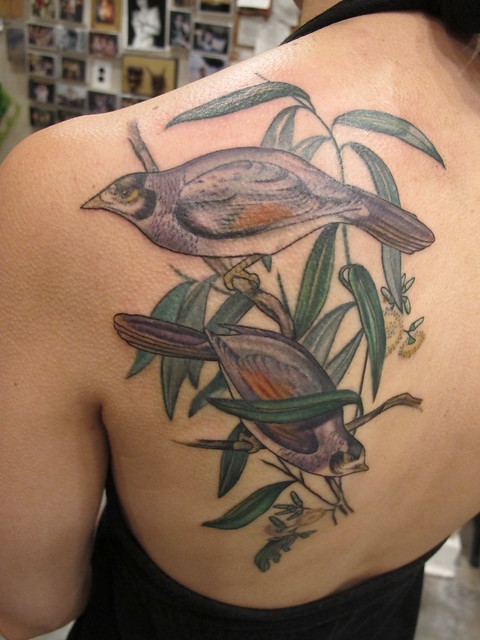
Last year, I got this done by Cindy at No Ka Oi Tiki Tattoo just south of South Street (I'm in her gallery too!):


You can read all about the significance of the image in these blog posts, but the short of it is that these are noisy miner birds as depicted in John Gould's The Birds of Australia. I've been thinking about getting something on my right upper arm for a while. I wasn't really sure what I wanted, or even if it would be similarly ornithological, but while doing some idle browsing on the topic of Gould this week, I came across some interesting information.

Edward Lear — yes, he of "Owl and the Pussycat" fame, though my favorite of his poems is "The Dong with a Luminous Nose" — was once an ornithological illustrator. In fact, John Gould employed Lear (without crediting him) for many years to help him with his publications, and Lear taught Gould's wife how to make the lithographs for Gould's works, and drew all of the backgrounds. Lear's own ornithological specialty was parrots; he would spend hours at the London Zoo's Parrot House drawing birds from life, including several Australian species. I sought out his lithographs, and I think they are breathtaking. Frankly, he is a far better artist than Gould or his wife. Here is a selection from his own book The Parrots, but this one is my favorite, which was included in The Natural History of Parrots by Prideaux John Selby (1836):


(I've cleaned up the colors and altered some of the background.)

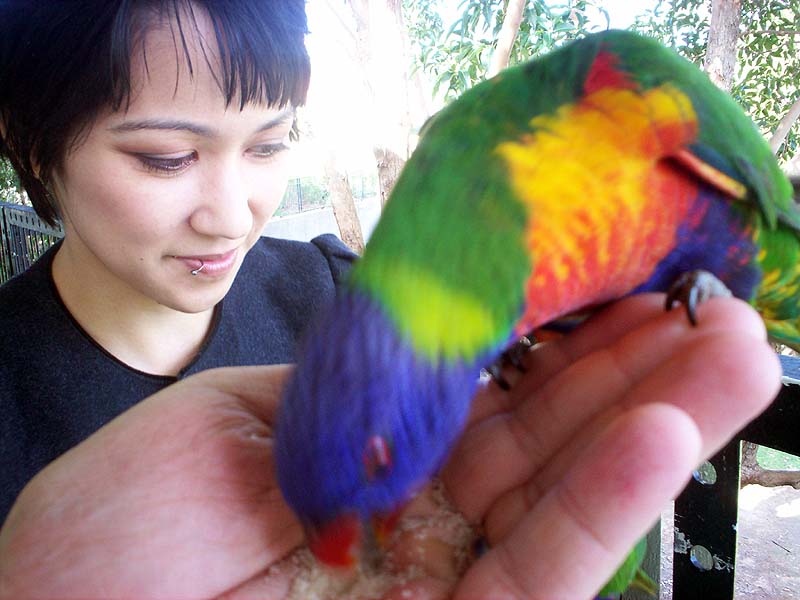
When I was growing up in Queensland, one of my favorite zoo-type places to go was Currumbin Sanctuary, whose main draw is scheduled rainbow lorikeet feedings that attract hundreds and hundreds of birds, all happy to land on your head and shoulders for a taste of nectar. Later, in Sydney, I lived for a drunken period with far too many college friends in a two-bedroom third-storey apartment with a balcony. Every morning just after dawn, huge flocks of rainbow lorikeets would crowd the railing of our balcony and screech like it was judgement day. It was deafening. I still cringe to remember the effect on my poor hungover head. As much as I swore and threw objects in their direction at the time, I've missed them. The closest thing to such a striking bird here in Philadelphia is the cardinal, and they don't have nearly as much personality.

When Matt and I visited Australia again in 2006, I took him to Taronga Zoo, where the wild lorikeets are so tame they will perch on your hand at the cafe and go for packets of sugar.


They are so numerous and destructive in Australia that they've been designated a pest by the government (similar to the noisy miner — apparently I have a cheeky soft spot for native Australian birds that do the opposite of become extinct after urbanization). Despite this, I was shocked when I came to America and saw two rainbow lorikeets in a pet store in Central PA. They looked utterly miserable, huddled in a corner of their cage with dull feathers. It didn't seem right.

Anyway, I'll let the idea sit for a few weeks at least before I decide.

Friday, May 03, 2013

I am a woman. I am a composer. I am a woman composer.

Being a female composer is weird for the simple reason that there aren't very many of us and we aren't all that visible. (Being a female composer of color is even weirder.)

I've been calling myself a composer for about six years now, and over that time, I've become more and more conscious of my gender, and to a lesser degree, my ethnicity. Maybe at first I was just so narcissistically excited to think of myself as a composer at all that I didn't notice my colleagues' background. Once I started taking notice, however, it became a game at new music concerts to survey all the composers forced to take those terrible awkward bows from the audience after their pieces have been performed (God, I hate taking those bows). And the result?

The vast majority of composers are white men of average build with brown hair and glasses.


I don't have a scientific survey, but a tally of the people around me suggests that this majority is upward of 80%. Sometimes gaggles of composers look so similar that I can easily imagine they are all siblings in some incredibly musical quiverfull family whose father only shoots Y-chromosome sperm.

Some composers are older and their brown hair has turned grey or white, and sometimes they wear contact lenses instead of glasses, but for the most part, this stereotype is confirmed over and over again. Very occasionally the composers are Hispanic or Asian, but they usually retain the characteristics of maleness and having average build and brown hair and glasses.

I'm not saying that there is anything wrong with being an average-looking white guy with brown hair and glasses. They're not actively oppressing anyone just by being who they are. Nobody who fits this description should have to feel guilty about it. And obviously there are exceptions to this rule. But the stereotype applies to the point where I'm often left giggling at its absurd ubiquity.

So what the hell does this mean? We live in a world brimming with all kinds of gender (and racial) equality now, right?* Why aren't there more female composers around? Are the institutions sexist? Are the judging panels of composition contests and the programmers of concert series sexist?

I don't think they necessarily are, or at least, I don't think that's the real root of the problem. Institutions, judging panels, and programmers just exist in a world where the vast majority of all composers are already white men of average build with brown hair and glasses, and that majority isn't changing very quickly. How can you demonstrate equality between the sexes in any concert series when maybe one in ten composers out there are women?** You can't just pluck women at random from the street and ask them to compose some art music. It takes years of training, and of course, they have to want to do it in the first place.

And thus the problem is perpetuated because the example is very firmly set for younger generations: "Hey, kids! Composers look like white guys with brown hair and glasses. They've looked like this for 600 years, and they look the same way now."

When you're a child, you absorb all kinds of things about gender from the moment you start interacting with the world. Men are heroes, and women are princesses to be won. Men are doctors, and women are nurses. Alpha-male businessmen have ultra-feminine secretaries.

Quick: picture a firefighter. He's a man, right?

Quick: picture a professor. If you didn't think of an old white guy, you are a very unusual person.

Quick: picture a kindergarten teacher. If you didn't picture a woman, you are again a very unusual person.

I've worked with little kids a fair bit as a theater/acting educator, and something I notice about them is that you very rarely meet a little boy who wants to be a nurse or a teacher when he grows up. For whatever reason, little boys have been socialized to think of these jobs as unsuitable for them. You also don't find a lot of little girls wanting to be pilots or engineers or firefighters. Of course, when they grow older, they sometimes learn that these traditionally gendered careers are open to them after all, and they occasionally follow those paths. But still, over 90% of registered nurses are female. Over 80% of engineers are male.***

Now ask a musically literate child to think of ten composers. If she can name that many, how many do you think will be women? How many of the compositions that child has learned to play do you think are by women?

Knowing this, how many little girls do you think might want to be composers when they grow up? How many little girls even realize they can be composers? How many have even had the idea?

Maybe, just maybe, there's a reason that, despite being a musician all my life, I didn't even think about becoming a composer until I was 24, and I didn't call myself one until I was 26.

(Related: how many black children do you think want to be art music composers when they grow up? Funny story: like every other clunky-fingered beginner pianist, I learned The Entertainer as a child, but I am horrifically ashamed to admit I only found out last year that Scott Joplin was black. The internet didn't exist when I learned The Entertainer, I'd never seen a picture, and nobody ever mentioned to me that he was black, so by default, I had always pictured him as a white guy (probably wearing a boater hat). Shocked and mortified by my own ignorance, I informed my husband how dumb his wife was, and he had to admit that, until that moment, he also had not known that Scott Joplin was black, despite learning about ragtime in high school music class. Nobody had told him either.)

One of the pressures that I feel as a woman composer is my own desire to demonstrate to future generations of little girls that composers aren't just white men with brown hair and glasses. Even though most of them still are. The only way the demographics are going to change is if we go in at the ground level. We need young girls and boys to see that composition is not a gendered pursuit, not just by telling them so, but by showing them. We need a Girls Rock Philly organization for classical music — or maybe there would be a way to fit classical music into their mission? I don't know — I haven't approached them, though I absolutely love what they do. I really want to volunteer with them once my schedule allows i.e. after Ayn. I want to start a composition school for girls.

Maybe I'm doing myself no favors, but I don't feel it's enough for me to exist as a composer and forget about the "woman" part. I personally feel an obligation to be more visible if I can be, to make up for the fact that I'm such a minority, so that it's not such a fucking embarrassment to new music that all the composers taking a bow look exactly the same. With the situation as it is, women composers need to shine brighter than their abundant male counterparts so that eventually, one frabjous day, so many aspiring girls will take our place that we will be able to forget about the "woman" part. That day has not arrived. Yeah, this is problematic; that's a lot of pressure to place on current women composers. It makes things unequal for us. It contributes to the sense that in order to make it, we have to work twice as hard. It confirms the idea that the default majority can make it as individuals, but minority artists are forced to represent their entire group. But I'd rather do that than pretend there isn't an imbalance and do nothing, which is about as useful a solution as calling myself George and wearing a top hat. ("Hey kids! Composition is such a male pursuit, I had to become a man in order to do it!")

(Tangentially related: I think it would be really interesting to study how the demographics of forensic scientists, particularly forensic pathologists, have changed since the 1980's. I've mentioned this before: I watch a lot, I mean a lot of television detective shows, particularly police procedurals, and it seems like virtually every TV forensic pathologist is a woman now. I enrolled in med school in 1997 only because I wanted to be a forensic pathologist (and quit when I realized there weren't enough jobs in Australia in that field); I have no doubt now that this desire was in part inspired by The X-Files and Patricia Cornwell, and there are even more fictional examples of female FP's now. Has fictional representation in the media done anything to affect gender distribution in forensic pathology more than other medical fields? I'd be so curious to know.)


I am woman, hear me ... make woman music

Here's a confession. When I first decided to become a composer, I bristled at the idea that I was a "female composer." I felt there was a stereotype about the kind of music that a female composer would write, and I didn't want to fit that mold. What can I say? I hadn't really thought deeply about the reasons behind my views. I had just finished a long fling with industrial music, which is deeply gendered and whose fans can be quite sexist when explaining their musical preferences ("I don't like female-fronted bands."). I wanted to make it in a man's world writing MANLY MALE MUSIC like all those MAN COMPOSERS I had admired all my life. The ultimate expression of (second-wave) feminism, right?

Of course, this brings up a huge, touchy question. Do female composers and male composers write different kinds of music? I don't claim to have any kind of definitive answer. We are almost certainly socialized very early on to believe that there is some level of gender differentiation in music. Society still tends to squeeze everyone and everything into categories of feminine and masculine. Boys are given trucks to play with and encouraged to listen to loud tough music. Girls are given dolls to play with and encouraged to listen to pretty soothing music. By the time you reach middle school, there are at least some boundaries set, sad as they may be. A boy would probably catch hell for being into female pop bands. A girl is flying a tomboy flag if she's into heavy metal. A lot of children start throwing around slurs when they see peers not behaving in a strictly heteronormative way. Children learn to conform, no matter how much we ask them to be brave.

I brought this discussion up on a Facebook thread the other day, and a friend made a comment that got me thinking:
But do you find it worth exploring, like an evolutionary psychologist might, whether there are some maybe biological underpinnings for the different sorts of music they're likely to write and play?
My first impulse was to yell NO!! We are all forced to conform! We're all the same deep down! But then I wondered. And I remembered: biologically, women and men do perceive things differently. Take color. Women see more yellow in green and more red in orange than men do. Far more men are colorblind, but now we've discovered that some women are tetrachromats and see 100 million more colors than men. Where sound is concerned, women have a faster and more negative reaction to a baby's cry than men, to encourage/force them to look after their squalling young (a nasty evolutionary trick that helps explain why I become highly anxious on airplanes when a baby starts screaming, while Matt takes it perfectly calmly). Along the same lines, men and women have very different sensitivities to sounds, at least when sleeping. A crying baby is the sound most likely to wake a woman. The sound isn't even in the top ten for men, who are more likely to react to a car alarm.

If our senses are calibrated differently, wouldn't that have some kind of influence on our artistic taste? What kind of influence? (Maybe I don't like some types of dissonant music because they sound too much like babies crying? she ponders facetiously) It's a very complicated question, and any answer would be less than universal. But I have to wonder: if there were more women composers, would art music sound different? At some level, do women feel, like I once did, that they should make an effort to write like men, because male composers set all the examples we study in school?

Maybe these are stupid questions. I don't know. All I know for sure is that, six years ago, I had internalized some horrible idea that my music shouldn't be too "feminine," whatever the hell that means, because somehow "feminine" was bad. "Feminine" wouldn't be taken seriously enough by the art music world. People would roll their eyes and dismiss me as a wishy-washy woman composer. I hate that I held this attitude. It wasn't something at the forefront of my mind, I didn't express it in any overt way, but it was there. Ugh ugh ugh.

So here it is. I am a woman composer. I don't set out to write "feminine" music, but if anyone were to find it feminine, including myself, fine. Good. We have had 600 years of music written by men, 600 years of being told that that is what art music is. If—if—our music is different in any way, we shouldn't shy away from that. We shouldn't deny our gender.

And if we write "masculine" music, that's good too. But it's not better.

Maybe I'm the only person in the world to have internalized these ideas to the point where I have to talk myself out of them in a therapeutic blog rant. I doubt it, though.

*Hahahaha.
**Without affirmative action, that is (OOGER BOOGER).
***Not even getting into women of color here because it's too depressing.

Sunday, March 10, 2013

Eat, Compose, Love

Bless me, Blogger, for I have sinned. It has been two months since my last entry.

Right this instant I am exhausted.

At long last, for about a month now, I have had only one project on my plate: Ayn. I have been on this earth for nearly 33 years, and this singularity of purpose is unprecedented. But for some stupid reason, I feel more tired for it. Perhaps, with less noise, I am able to feel the accumulated weariness for the first time. In any case, I'm making progress on the opera — slow progress, but progress nevertheless — but when the notes come out sounding like garbage because my brain has run out of juice for the day, I find myself totally confused and lost by the lack of other items on my to-do list. I pace around mindlessly like a broken Roomba. I don't think I've ever dealt with feeling like this before. It's an experiment.

A couple of old projects have managed to demand my attention recently, however. The most notable news is that Tesla's Pigeon will be performed in New York City next month, thanks to this wildly successful ongoing kickstarter campaign I launched ten days ago:


It's a little overwhelming to receive so much support from friends near and far — and even a few total strangers. And since the campaign also introduces my current project publicly, the pressure is on for Ayn. I have expectations to fulfill, theirs and mine.

Meanwhile, the Tesla's Pigeon concert will be at 7:30PM on April 22 at Christ & Saint Stephens Church. I'll post more about it closer to the date.

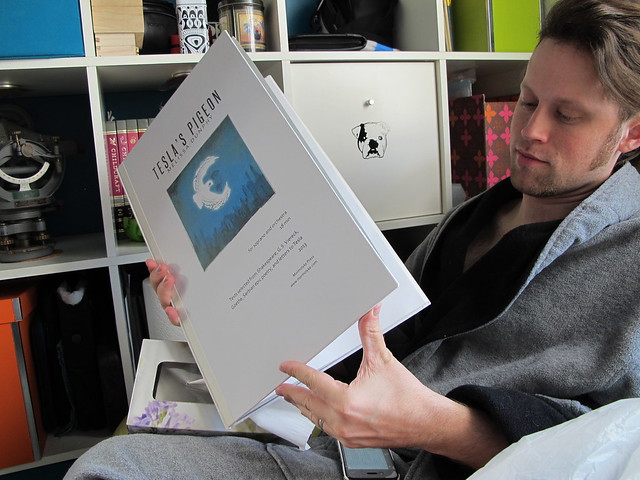
Then, exactly a week later, Jess and the Curtis Symphony will record my orchestration of Tesla's Pigeon, which I was feverishly arranging when I wrote my last blog entry. I'm pretty excited to hear it played, even if it does create some non-Ayn noise in my head. I spent rather too much time in January learning how to bind books so I could make a hardcover score, which kicks some serious arse over the spiral binding that is the standard:

Matt (with the flu) opens my very first hardcover bound score - Tesla's Pigeon for soprano and orchestra

^^ These are also available as a reward on the Kickstarter campaign.

This afternoon, the Kennett Symphony Orchestra and Children's Chorus will give the second of two children's concerts featuring my brand spanking new revision of Jack and the Beanstalk at my alma mater West Chester University; last summer, I tore into the first edition, ripped out and abridged some movements, interpolated some new songs (including the most ridiculously catchy number I've ever written in my life, "These Beans"), added some lyrics to existing instrumental melodies, and rearranged the whole thing for chamber orchestra. It's shorter, but I think it's way better. Judging from the post-performance reactions last week, the kids seem to enjoy it, which is about the best compliment a composer can get; kids that young are unabashedly honest, and they're difficult to fool. Of course, everyone is nuts over "These Beans," but unfortunately, I can't let you hear a recording because of the stipulations of the Musician's Union. I might have some choice words on that matter in a later post.

Captain Samuels Speaks to the Sea! made its UK debut in February at the Two Rivers Festival, the first time any piece of mine has been performed over the pond as far as I know. I am surprisingly proud of that piece. I started listening to it the other day and found myself quite liking it, and I played it all the way through, good heavens. I know that sounds a bit batty, but I don't do much playback of my finished pieces because I start to pick at them and want to change them, and I'd rather write new stuff.


On a non-musical note, last month Matt and I got the results of our DNA test from 23andMe. If you have $99 to spare, I highly recommend it; fascinating stuff, especially for someone like me descended from immigrants who tend to leave the past behind and have no interest in genealogy. As far as recent ethnic background is concerned, I didn't find out anything I didn't already know: my mother is a Chinese as they come, and my father is as Greek as they come. The only surprise was 2% Italian heritage on my father's side, which really isn't all that surprising at all. Of more interest is the data from further back: I have 3.1% Neanderthal DNA, which puts me in the 98th percentile. I thought this was pretty badass until Matt looked at his DNA profile: he has 3.2% Neanderthal DNA, placing him in the 99th percentile. That's about as close as we come to being related.

Sunday, January 06, 2013

Orchestrating Tesla's Pigeon, Part 2

I took the day off today. Matt and I ran errands and visited Philly Electric Wheels to try out one of their new electric bikes I've been eyeing up to replace my old clunky 68-pound eZip*. I would like to get back into commuting on two wheels (hopefully without being physically attacked or hit by a car) because I am quite possibly the most unfit able-bodied person on the planet. Like, I test-rode the bike -- an electric pedal assist bike -- for maybe two blocks and back, and now my quads hurt. What.

This week has reminded me why I procrastinate so heavily before working on a composition. It takes over everything. I lost five pounds in five days because I forgot to eat and my brain was burning fuel overtime. I forgot how to interact with people. I slept poorly, woke early, and went straight from my bed to my office like a zombie. I neglected my husband. I let some of my plants die. I didn't do any housework.

Instead, I threw together a 55-page orchestral score. Thank god for Sibelius keyboard shortcuts; even as good as I am with them, the wrist on my mouse hand is sore. Yesterday I tried to take a break. Do something else! my body screamed at me. You cannot sustain this level of focus! What I ended up doing was cutting some 100lb paper to 10 by 13 inches in order to eventually print parts on them, and after about an hour of guillotining, I went back to working on the score.

Today I finally tore myself away, and now I don't want to go back for a while. But I'm seeing my teacher on Thursday, so I'm sure that will suck me back in to endless tweaking and formatting, and I'll have ECU tendonitis before you know it.

Speaking of Tesla, tomorrow I have to get up at the crack of dawn and drive myself and my long-suffering husband to the New Yorker Hotel in Manhattan for the inaugural Tesla Memorial Conference. Tesla's star sure is on the rise, and it's neat that I'm apparently a part of that. I'm giving a short talk at the 5:00PM session, but I'll be hanging around all day. Hey, maybe they'll let me go in his old room.

Oh, by the way, there are some moments in the orchestration which I am REALLY REALLY happy about. The Wagnerian harmonies in song VII are going to sound so freaking boss on brass, and song VI was basically written for harp; I barely had to make any adjustments (although those adjustments took forever, because I had to remember how harp pedaling works).

Of course, the *real* reason I'm working this hard is because I'm procrastinating Ayn. Sigh.

* The Fast4Ward Edge, if you're interested. This would be the most expensive bike I've ever owned by a factor of 5.

Thursday, January 03, 2013

Orchestrating Tesla's Pigeon

I've been talking idly about arranging Tesla's Pigeon for orchestra for a long time. Ever since writing it, I've clearly known which instruments are supposed to be playing each line. Maybe this has something to do with what a crap pianist I am; even when I'm writing for piano, I'm not really writing for piano.

Anyway, I started by sitting down this weekend with this awesome score of the Ravel orchestration of Mussorgsky's Pictures at an Exhibition that I found in my room. I have no idea how it got there -- did someone give it to me? Did I buy it one day knowing I'd need it? At any rate, I pulled it out along with the piano score, only to discover that BY GOD these Eulenburg geniuses have included the original piano in the orchestral score for reference. Modern convenience. So great. Thank you, whatever unseen force put this score on my shelf.

The solstice is past, and I can feel my body and brain slowly turning toward the spring and seeing light at the end of a seasonally depressed tunnel. It's been a nasty slump this winter. The one "good" thing about depression is that it sometimes precipitates very intense emotional reactions -- to music, for example. So long as I'm not out in public or trying to drive straight, I appreciate them. I listened to Pictures at an Exhibition by myself with my handy Eulenburg Edition score on Sunday, and by the time I walked past the Great Gate of Kiev, I had completely lost it. I was literally sobbing. Sobbing! I mean, sure, I love that piece. I played it with QYO back in the day, and most of the pieces I played in my mid-teens made a huge impression. But: heaving sobs ... I haven't had that happen during a piece since I accidentally caught the Alpine Symphony on NPR back in 2008. Funnily enough, I played that with QYO too. Probably something to be said about that.

God, Ravel is good.

My hope is that I will have it orchestrated by the time school starts next week, and that the Curtis Orchestra will read it this semester. With Jess Lennick on pipes, naturally. I've made a cracking start: all the main stuff has been parceled out to the appropriate instruments, and now I just have to embroider. Oh, and create parts, I guess. Ugh.

I am heading to bed with this Eulenberg score. It's even a convenient bed-reading size. Such a fan.