Showing posts with label Ayn. Show all posts

Tuesday, April 29, 2014

The worst part of composing

Everyone has their own damn hell to push through, but here's mine: after months, nay, years, of feeling creatively kind of constipated (refer to multiple posts about depression on this very blog), I go back to a theme I smeared on the page maybe a year ago, and I hate it. It's supposed to be a twisted love theme. It's shit. It's a turd that I have tried multiple times to polish, but all it does is smear into ever more bland and messy stains. I decide to scrap the entire theme and do the whole damn thing over, which is going to affect a bunch of other moments and scenes, but whatever; they're all shit, contaminated by the stink of this stupid theme. They all need to be rewritten. In fact, most of the scenes in question need to be written, never mind the re-, so who cares; I may as well start over. After hours of staring at the newly blank staves while too afraid to move, I finally write a different theme. I think it's better, but I'm not sure. I worry that I'm second guessing this brand new theme. But then, I was second guessing myself by scrapping and rewriting the original theme, so actually, this is at least the third guess. I'm starting to think everything is a damn guess, and none of the guesses are close to the mark.

Sometimes I really wish I could trust myself. But if I do, and the result is a giant smear of excrement, well, that won't do at all, will it?

In conclusion, I hate everything.

Sunday, March 10, 2013

Eat, Compose, Love

Bless me, Blogger, for I have sinned. It has been two months since my last entry.

Right this instant I am exhausted.

At long last, for about a month now, I have had only one project on my plate: Ayn. I have been on this earth for nearly 33 years, and this singularity of purpose is unprecedented. But for some stupid reason, I feel more tired for it. Perhaps, with less noise, I am able to feel the accumulated weariness for the first time. In any case, I'm making progress on the opera — slow progress, but progress nevertheless — but when the notes come out sounding like garbage because my brain has run out of juice for the day, I find myself totally confused and lost by the lack of other items on my to-do list. I pace around mindlessly like a broken Roomba. I don't think I've ever dealt with feeling like this before. It's an experiment.

A couple of old projects have managed to demand my attention recently, however. The most notable news is that Tesla's Pigeon will be performed in New York City next month, thanks to this wildly successful ongoing kickstarter campaign I launched ten days ago:


It's a little overwhelming to receive so much support from friends near and far — and even a few total strangers. And since the campaign also introduces my current project publicly, the pressure is on for Ayn. I have expectations to fulfill, theirs and mine.

Meanwhile, the Tesla's Pigeon concert will be at 7:30PM on April 22 at Christ & Saint Stephens Church. I'll post more about it closer to the date.

Then, exactly a week later, Jess and the Curtis Symphony will record my orchestration of Tesla's Pigeon, which I was feverishly arranging when I wrote my last blog entry. I'm pretty excited to hear it played, even if it does create some non-Ayn noise in my head. I spent rather too much time in January learning how to bind books so I could make a hardcover score, which kicks some serious arse over the spiral binding that is the standard:
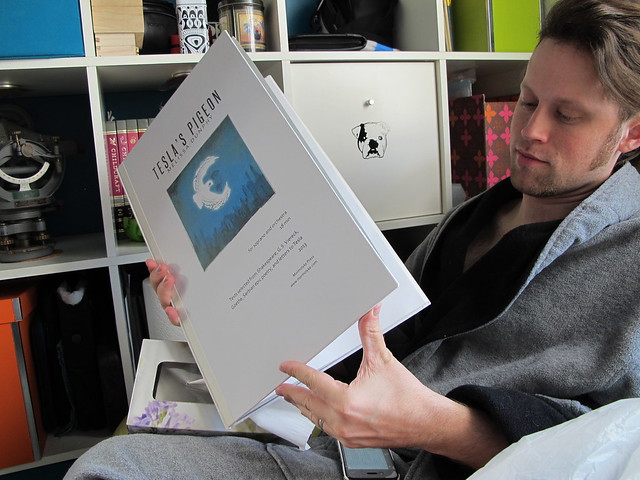
Matt (with the flu) opens my very first hardcover bound score - Tesla's Pigeon for soprano and orchestra

^^ These are also available as a reward on the Kickstarter campaign.

This afternoon, the Kennett Symphony Orchestra and Children's Chorus will give the second of two children's concerts featuring my brand spanking new revision of Jack and the Beanstalk at my alma mater West Chester University; last summer, I tore into the first edition, ripped out and abridged some movements, interpolated some new songs (including the most ridiculously catchy number I've ever written in my life, "These Beans"), added some lyrics to existing instrumental melodies, and rearranged the whole thing for chamber orchestra. It's shorter, but I think it's way better. Judging from the post-performance reactions last week, the kids seem to enjoy it, which is about the best compliment a composer can get; kids that young are unabashedly honest, and they're difficult to fool. Of course, everyone is nuts over "These Beans," but unfortunately, I can't let you hear a recording because of the stipulations of the Musician's Union. I might have some choice words on that matter in a later post.

Captain Samuels Speaks to the Sea! made its UK debut in February at the Two Rivers Festival, the first time any piece of mine has been performed over the pond as far as I know. I am surprisingly proud of that piece. I started listening to it the other day and found myself quite liking it, and I played it all the way through, good heavens. I know that sounds a bit batty, but I don't do much playback of my finished pieces because I start to pick at them and want to change them, and I'd rather write new stuff.


On a non-musical note, last month Matt and I got the results of our DNA test from 23andMe. If you have $99 to spare, I highly recommend it; fascinating stuff, especially for someone like me descended from immigrants who tend to leave the past behind and have no interest in genealogy. As far as recent ethnic background is concerned, I didn't find out anything I didn't already know: my mother is a Chinese as they come, and my father is as Greek as they come. The only surprise was 2% Italian heritage on my father's side, which really isn't all that surprising at all. Of more interest is the data from further back: I have 3.1% Neanderthal DNA, which puts me in the 98th percentile. I thought this was pretty badass until Matt looked at his DNA profile: he has 3.2% Neanderthal DNA, placing him in the 99th percentile. That's about as close as we come to being related.

Thursday, October 04, 2012

Elegy for a Soprano

As you can probably tell, I've been doing an awful lot of Ayn reading these past few weeks; I realized there are some slippery things about the material and the dialogue and the characters' voices that I need to get a handle on before I can continue with the opera.

One of the books I whipped through was The Ayn Rand Cult, which was a fun read (even if there were a few weird misspellings like "Dagney" and some stretchy conclusions and assumptions):


I can't seem to definitively find Jeff Walker, a Canadian journalist, on an online social medium where I can casually interact with him, which is a surprising and a little disappointing, because if nothing else, I want to thank him for alerting me to the existence of Kay Nolte Smith's novel Elegy for a Soprano, which I cannot believe I didn't know about until now. That will teach me to stick to the non-fiction shelves.


Blurb:
THE DEATH OF A DIVA
Dinah Mitchell is saddened when she learns her favorite opera star, Vardis Wolf, has been poisoned - especially when she discovers that the woman behind the beautiful voice was her natural mother. Dinah journeys into the dark world of genius, driven to find out the truth about the singer's life ... and death.

Why is this so exciting? I hear you ask.
From the wiki of the author, Kay Nolte Smith:
She was for a time friendly with the philosopher-novelist Ayn Rand, who was her leading literary and philosophical influence... Smith launched her literary career after her separation from the Ayn Rand circle... Her novel Elegy for a Soprano is a roman a clef inspired by Rand, Nathaniel Branden, and the circle around them.

OH SHIT WHAT.

So I bought the book on Amazon, and I hardly dared to hope, but YES YES YES the stand in for Ayn Rand is the eponymous soprano! OMG SO PERFECT! She's like Rand crossed with Callas. As the wiki suggests, other lead characters including a very obviously drawn pseudo-Frank, pseudo-Nathaniel, and pseudo-Barbara, and a possible pseudo-Leonard.

AND HOLY SHIT the novel opens with Vardis/Ayn singing Salome, and of course the whole story is soaked in opera. So freaking perfect. It's also an easy-reading page-turner, especially for someone like me who has a thing for mystery novels, and it takes an unexpectedly moving left turn into the Holocaust at the end.

In case you couldn't tell, my Ayn is also a soprano. I feel quite validated that someone who actually knew her would also portray her as a soprano in pseudo-fiction.

Monday, October 01, 2012

What the hell kind of music does Richard Halley write, anyway?

Last week I read Atlas Shrugged, and I have so, so many things to say (or rather "scream" as EVERYONE IN THE BOOK DOES, CONSTANTLY) about so, so many things, but as a composer, I wanted to point this one out in particular.

There is, remarkably, a composer woven into the narrative named Richard Halley. Although we don't know the exact nature of his music, it is evidently so wonderful and heroic that a mere melody written by him, whistled by a stranger completely without context, transports hero industrialists into ecstasies of delight that cause them to extrapolate an entire orchestration in their imagination. No, really, that happens.

Later, we get to meet Richard Halley, who has withdrawn completely from the world and is hiding out in Galt's Gulch, much to the delight of fangirl Dagny. He furnishes her and us with an explanation for his disappearance (see below for TL;DR, because omg writing):
"I would have forgiven men for my struggle," said Richard Halley. "It was their view of my success that I could not forgive. I had felt no hatred in all the years when they rejected me. If my work was new, I had to give them time to learn, if I took pride in being first to break a trail to a height of my own, I had no right to complain if others were slow to follow. That was what I had told myself through all those years —except on some nights, when I could neither wait nor believe any longer, when I cried 'why?' but found no answer. Then, on the night when they chose to cheer me, I stood before them on the stage of a theater, thinking that this was the moment I had struggled to reach, wishing to feel it, but feeling nothing. I was seeing all the other nights behind me, hearing the 'why?' which still had no answer—and their cheers seemed as empty as their snubs. If they had said, 'Sorry to be so late, thank you for waiting'—I would have asked for nothing else and they could have had anything I had to give them. But what I saw in their faces, and in the way they spoke when they crowded to praise me, was the thing I had heard being preached to artists—only I had never believed that anyone human could mean it. They seemed to say that they owed me nothing, that their deafness had provided me with a moral goal, that it had been my duty to struggle, to suffer, to bear—for their sake—whatever sneers, contempt, injustice, torture they chose to inflict upon me, to bear it in order to teach them to enjoy my work, that this was their rightful due and my proper purpose. And then I understood the nature of the looter-in-spirit, a thing I had never been able to conceive. I saw them reaching into my soul, just as they reach into Mulligan's pocket, reaching to expropriate the value of my person, just as they reach to expropriate his wealth—I saw the impertinent malice of mediocrity boastfully holding up its own emptiness as an abyss to be filled by the bodies of its betters—I saw them seeking, just as they seek to feed on Mulligan's money, to feed on those hours when I wrote my music and on that which made me write it, seeking to gnaw their way to self-esteem by extorting from me the admission that they were the goal of my music, so that precisely by reason of my achievement, it would not be they who'd acknowledge my value, but I who would bow to theirs. . . . It was that night that I took the oath never to let them hear another note of mine.

(TL;DR I suffered for a long time because my music was so innovative that nobody liked it. Then one day, I achieved acclaim with one of my pieces. But while they were cheering, the audience didn't once apologize for not liking my music before! Instead they acted like it was my job to teach them how to enjoy my music! They thought I was writing my music for them! Those looters! I will never let them hear my music again!)

Well! Let's put aside what I might think of this attitude for a moment, because I am clearly an immoral moocher-lover. Given that Ayn was writing this in the 1940's and 1950's, one might assume that she is portraying a composer of modern music, right? It makes sense. I mean, if anyone could be accused of writing music that audiences had to be taught to enjoy, it would be the Second Viennese School (and I think it could be argued that audiences still haven't learned to appreciate them). And "Who Cares If [They] Listen" anyway. So in my head, Halley was a mighty expressionist. Let's hear a hearty cheer from the atonalists out there! Ayn Rand, for all her faults, is championing your music and your struggle!

You can guess where this is going.

What's this? From the book What Art Is: The Esthetic Theory of Ayn Rand (good lord):
A brief word about so-called modern music: no further research or scientific discoveries are required to know with full, objective certainty that it is not music. The proof lies in the fact that music is the product of periodic vibrations -- and therefore, the introduction of nonperiodic variations (such as the sounds of street traffic or of machine gears or of coughs and sneezes), i.e., of noise, into an allegedly musical composition eliminates it automatically from the realm of art and of consideration. But a word of warning in regard to the vocabulary of the perpetrators of such "innovation" is in order: they spout a great deal about the necessity of "conditioning" your ear to an appreciation of their "music." Their notion of conditioning is unlimited by reality and by the law of identity; man, in their view, is infinitely conditionable. But, in fact, you can condition a human ear to different types of music (it is not the ear, but the mind that you have to condition in such cases); you cannot condition it to hear noise as if it were music; it is not personal training or social conventions that make it impossible, but physiological nature, the identity, of the human ear and brain.

WOMP WOMP.

I find this deeply hilarious.


Friday, March 23, 2012

Ayn Rand saw aliens

From Ayn Rand and the World She Made by Anne C. Heller:
One Saturday afternoon, Rand greeted the Hills by beckoning Ruth upstairs, unto the immense master bedroom, where tall glass windows lined a wall to the left of the bed. "Do you see those junipers?" she asked, pointing to a row of twelve-foot bushes about half an acre from the house. "A UFO came by there last night." Stunned, Hill asked for details. "It was hovering just above the junipers and then flying in slow motion," she said. It was round and its outer edges were lighted, she continued, and it made no sound. By the time she woke Frank and led him to the window, it had moved out of sight. "Did you really see this?" Hill asked. "I saw it," said Rand. The story seems to demonstrate her confidence in the ability of her mind to interpret the evidence of her senses. As the years went by, this particular confidence would not always serve her well.
Maybe ... maybe Ayn saw Stockhausen arriving from Sirius?

Oh, more stuff:
On the long drive in Frank's new Cadillac convertible, they stopped for a day or two in Ouray, Colorado, an old gold-mining town a few miles east of Telluride, whose surroundings contributed to the topography of Galt's Gulch. As they continued east, they may have passed the former site of Nikola Tesla's scientific laboratory, which had stood on a mountaintop near Colorado Springs in the early 1900's; the experiments the eccentric genius had made in harnessing electricity from the atmosphere and transmitting it wirelessly through earth and air may have provided a model for the revolutionary new motor invented by Galt. (Tesla also invented a fantastical but possibly workable "death ray" that Rand may have borrowed, in part, for Dr. Stadler's terrifying weapon, Project X.) Along with Edison, Tesla became one of Rand's models for her hero.