Showing posts with label music. Show all posts

Wednesday, December 21, 2016

Hervararkviða, or the Incantation of Hervor

Sea Tangle: Songs from the North

You might find this difficult to believe, but I am primarily a composer and not an amateur historian or archaeologist or theater builder/owner or whatever. To prove it, this year I wrote some music? Actually quite a lot of music, if I put it all together, although I am still way behind in my goals, because I will never be good enough and yes I do hate myself for it although I am trying to work on unrealistic expectations of myself in therapy thank you.

One of these pieces is being officially birthed into the world today (that is, Wednesday, December 21, 2016)! And if you are in the Philadelphia area, you are welcome to come witness its emergence in person, which will be beautiful and non-bloody and not at all like a real human birth. This piece was conceived way back in January, when I was approached by dreamy mezzo-soprano Maren Montalbano, she of the gorgeous silver curls and even prettier velvety silver voice, whom I knew through her work at Opera Philadelphia (we performed together in ANDY: A Popera),  Choral Arts Philadelphia (I wrote O Oriens for them last Christmas), and Twitter.

Monday, February 22, 2016

The Lola Ridge songs, in one convenient blog post

Three generations of women composers at the Volti Choral Institute: me (duh), high school senior Morgan Orsolini, whose choral work Awaken Again was among those performed, and the incomparable composer/pianist/conductor Sue Bohlin

A few weeks ago, I returned to frigid Philadelphia from California and immediately came down with a nasty case of the flu. My bad for procrastinating getting a flu shot this year until I forgot about it, but I'm also feeling some animosity toward the lady who open-mouth-coughed on me at the Saint Louis Airport on the trip home. I'm sure it was her. 

Then my cat Tripoli passed away last week. She was about 14 and it was her time to go, but both Matt and I are still a bit choked-up over it.

It's time to get back on the horse, though, especially since I am in happy possession of the results of my California trip: live recordings of all of my Lola Ridge songs.

Thursday, January 21, 2016

Six month catch-up

It's funny how the mind works in relation to reality. I've been avoiding writing a blog entry because I honestly thought I wouldn't have anything to report. But as I sat down today and forced myself to start looking back through my calendar and photos from the last six months, the evidence suggested otherwise.

I'll talk about what's happened in non-Hannah-related life first, and then write a separate entry explaining where we're at with the theater tomorrow. Spoiler: despite some effort, there has been little material progress, which is one disappointing reason it feels like I've done nothing at all. Also, I haven't finished my opera. And it's the middle of winter. And I'm processing some childhood emotional garbage and familial grief which I'm not going to go into, but which is seriously harshing any buzz I might have the energy left to muster.

But enough whining. In the last six months, I:

Thursday, June 25, 2015

The Hannah Callowhill Stage: Dream Brainstorm

Tripoli inspects my proscenium doodles
One of the most common questions I'm asked about the Hannah is: "What exactly are you going to do with the space once it's finished and open?" I have a lot of ideas. I don't know how many of them will end up on the cutting room floor, but maybe you'd like to know what I'm thinking.

Saturday, February 14, 2015

Music in The Cherry Orchard at People's Light

In rehearsal for The Cherry Orchard with Mary McDonnell. Picture by Emma Lee/WHYY.

About eight years ago, back when we lived in our Downingtown house and I was still actively auditioning as an actor, I heard that there was a professional theater close by holding an open call. I was pretty excited by the idea of potential employment at a theater that didn't involve a 30-mile commute to Philadelphia. Unfortunately, at the time the only monologue I had under my belt that I could whip out at a moment's notice was bloody Juliet and her stupid vial speech. Unsurprisingly, I did not get a callback.

(One day I will write a whole blog about how sick I am of Juliet. Short version: very.)

Fast forward to last year, and out of the blue, thanks to a recommendation, I was finally given my first opportunity to be a part of a production at that same theater—but primarily as a composer and sound designer, though I'm also playing the violin live on stage. Of course, now I've moved to Philadelphia, so I have a wretched 30-mile commute in the other direction.

But it's worth it.

Thursday, July 10, 2014

Happy birthday, Mr. Tesla

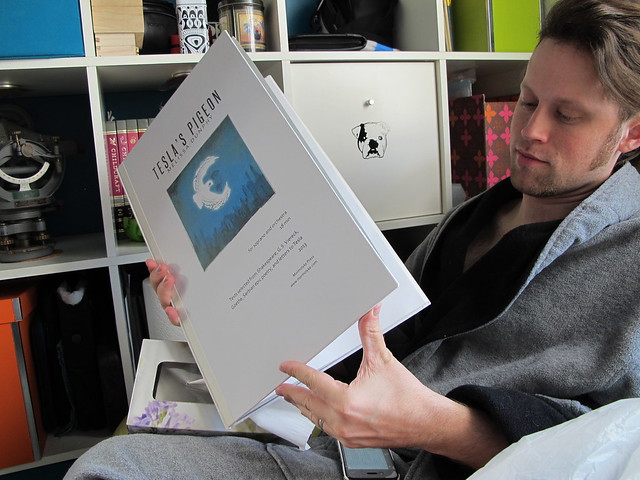
It's Nikola Tesla's 158th birthday! Along with all the other celebrations and million-dollar donations to museums in his honor, what better day to post the audio and photos from the performance of Tesla's Pigeon by the Secret Opera in New York City recently:

Tesla's Pigeon was sung in this performance by soprano Chelsea Feltman, accompanied by Joseph Yungen. Photos here are by Amanda Aulicino:

Friday, March 28, 2014

Have I mentioned lately how badly I want to be Peter Maxwell Davies' friend?

Click here to watch from 14:15 ...

Peter Maxwell Davies The Lighthouse Part 2

I took the liberty of transcribing the lyrics:

O my love I yearn for you,
Your hair of gold, your eyes so blue.
O that you held me in your arms.
I am transported by your charms.

In a meadow sweet, in a secret valley,
Resting on my staff, I muse and tarry.
Fast I come to where to where my love doth lie,
And all my senses sense defy.

From my sleep, so deep, so long,

by the cock crowing loud,
I am aroused.
My dream is flown.

O my love I dream of you
in a meadow sweet
from my sleep, from my sleep

Your hair of gold
in a secret valley
so deep, so deep

Your eyes so blue
resting on my staff
so long
I muse and tarry

Oh that you held me
fast
by the cock
in your arms
I come
crowing loud, crowing loud

I am transported
to where my love doth lie
I am aroused
by your charms, by your charms
and all my senses sense defy
My dream is flown

It's been a long time since I laughed that hard in an opera. Oh, Peter Maxwell Davies. I am so sure we would be friends.

Monday, January 20, 2014

Modern art gives me IDEAS

Last week, before we attended Waiting for Godot, we walked up to 53rd Street to grab some delicious street food from Halal Guys (so freaking cheap and great) and bumped into MoMa. There was a banner hanging outside for a Magritte exhibition that caught my eye because Godot and Magritte have bowler hats in common. It had been quite a few years since we'd been to MoMa—so many, in fact, that we weren't even sure if we had definitely been there, or if we were confusing it with a modern wing of the Met or some other art museum.

We also noticed that there's a Fogo de Chão right across the street. I'm pretty much always in the mood for Fogo de Chão. This calls for a second Manhattan date.

So we made a reservation for dinner, and yesterday, we drove up to NYC for the second Sunday in a row to take advantage of free parking and discover if we had been to MoMa before (yes, we had, but who needs an excuse to go again?). Unfortunatelyyyyyyy, the Magritte exhibition closed last Monday! Sadface. But looking through the glass doors of the roped-off gallery, we could see that they hadn't quite finished packing it away, which was honestly pretty interesting in its own way.


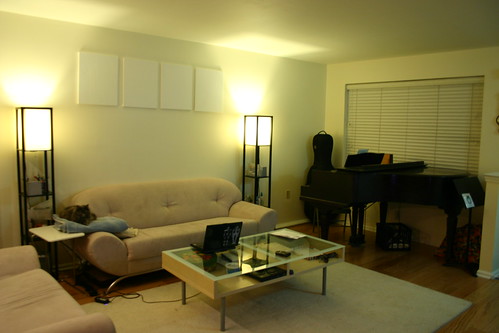
One of the things I love most about modern art is that it always gives me design ideas that I can use around my house. For example, after seeing the white paintings at the Guggenheim, Matt and I went all Rauschenberg in our living room:


A lot of people don't find modern art (or modern music) very accessible, but for DIY, it's a godsend. Hey, that design looks cool, and I can totally copy it, at least until I become a multimillionaire and can afford to support more artists by buying their stuff (unless they're dead, in which case they don't really need my support).

Here are the works I saw during this trip to MoMa that tasted ripe with DIY inspiration.

Joseph Cornell, Untitled (Bébé Marie), early 1940s

Joseph Cornell, Untitled (Hôtel Beau-Séjour), 1954

I saw these and immediately thought, OMG, I need to make some sweet dioramas/shadow boxes to hang on the wall, stat. Then I came home and read this post from user nickyskye on Metafilter:
[...] I was introduced to Cornell when I was 11. The person who introduced me had been told by a renowned art collector that "Joseph likes quiche lorraine and little girls". I was taken out to his place, 37-08 Utopia Parkway, Flushing in 1965 with that person, who had also purchased a quiche lorraine for the occasion, in case I wasn't a suitable offering. She wanted his art and I was going to be the bait used to procure it...
And now I feel a bit ill. Still. Dioramas.

Mondrian (duh), Broadway Boogie Woogie, 1942-43
Two words: Lego recreation.

Donald Judd, Untitled (Stack), 1967
Mmm, I can totally make a smaller-scale version of this by ombre-painting some Ikea Lack wall shelves. Total cost: maybe $70.

Here is something that might be my new favorite thing at MoMa (it was just installed last year):


If you want to see the video by itself, you can view it on YouTube, but I kind of loved watching it with the noise of the MoMa cafe close by and people walking past and little children meowing at the screen, so I've posted the crappy video I shot. This makes me want to make little films of all our cats and write some piano music for the soundtracks. And then project them looping on all our walls, all the time.

Speaking of cats, this sculpture reminded me of two of ours, Nairobi and Inky, who play-wrestle with each other constantly.

Maria Martins, The Impossible, III, 1946

While I'm veering off topic, I also want to mention the exhibition about women's influence on applied design and art that yielded some great feminist stuff like this:


...and this AMAZING music video, which caught our attention as soon as we were within earshot because you can sing Down In It to that beat all day. (Hrmmm!) Once we were within eyeshot, we were like, HEY that platinum-wigged lead singer kind of looks like me. (Crazy trivia: she is now a real estate agent in Austin.)


Finally, this piece brings this post and our consecutive weekend dates full circle.
Clearly, this man is waiting for Godot (even though he predates Godot by more than thirty years):

Elie Madelman, Man in the Open Air, c.1915


Wednesday, June 19, 2013

Link to composition news! Plus ... more avian Ink...?

I just sent out another edition of my e-mail blast, which has lots of lovely news in it, particularly recording news. You can read it here (and by the way, for the moment, you can subscribe to it here):


But for convenience's sake, here are some of the audiovisual elements:


Take note: Together is being performed TONIGHT at 8PM in Newport Beach, California, at the Choral Arts Initiative inaugural concert: details here.

You should also all go read this issue of Sound American, because I'm quite proud of having been interviewed, given the company I'm in.

###

On a completely different topic: they say tattoos are addictive.

Yeeeeaaah, maybe.

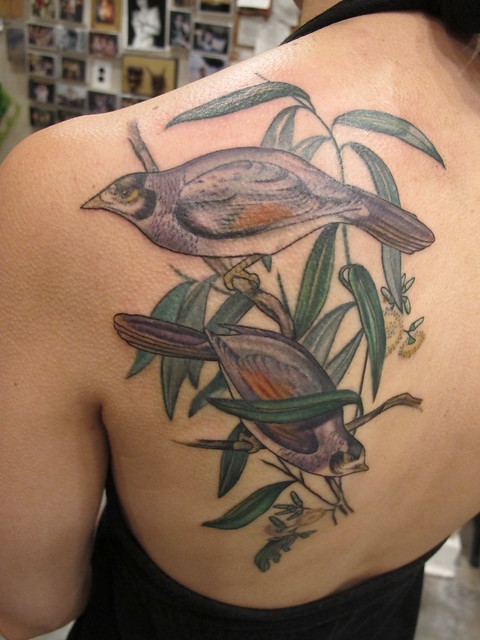
Last year, I got this done by Cindy at No Ka Oi Tiki Tattoo just south of South Street (I'm in her gallery too!):


You can read all about the significance of the image in these blog posts, but the short of it is that these are noisy miner birds as depicted in John Gould's The Birds of Australia. I've been thinking about getting something on my right upper arm for a while. I wasn't really sure what I wanted, or even if it would be similarly ornithological, but while doing some idle browsing on the topic of Gould this week, I came across some interesting information.

Edward Lear — yes, he of "Owl and the Pussycat" fame, though my favorite of his poems is "The Dong with a Luminous Nose" — was once an ornithological illustrator. In fact, John Gould employed Lear (without crediting him) for many years to help him with his publications, and Lear taught Gould's wife how to make the lithographs for Gould's works, and drew all of the backgrounds. Lear's own ornithological specialty was parrots; he would spend hours at the London Zoo's Parrot House drawing birds from life, including several Australian species. I sought out his lithographs, and I think they are breathtaking. Frankly, he is a far better artist than Gould or his wife. Here is a selection from his own book The Parrots, but this one is my favorite, which was included in The Natural History of Parrots by Prideaux John Selby (1836):


(I've cleaned up the colors and altered some of the background.)

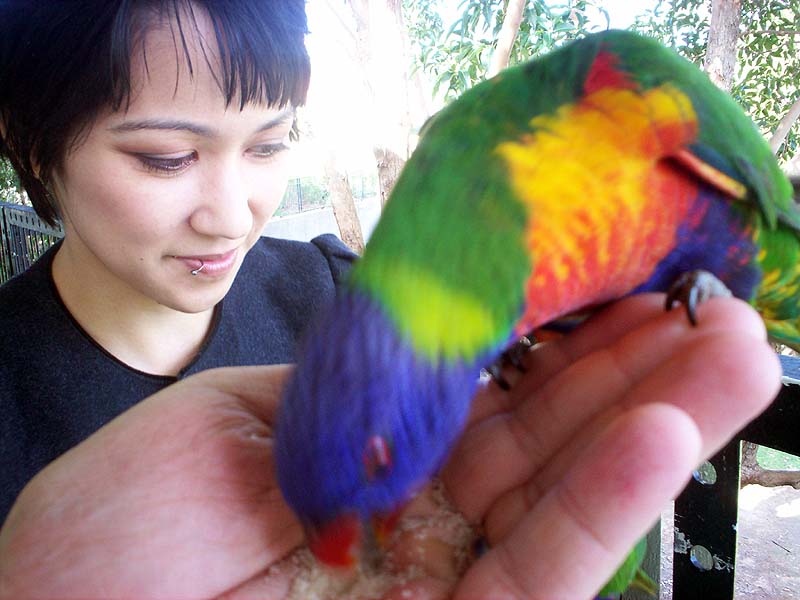
When I was growing up in Queensland, one of my favorite zoo-type places to go was Currumbin Sanctuary, whose main draw is scheduled rainbow lorikeet feedings that attract hundreds and hundreds of birds, all happy to land on your head and shoulders for a taste of nectar. Later, in Sydney, I lived for a drunken period with far too many college friends in a two-bedroom third-storey apartment with a balcony. Every morning just after dawn, huge flocks of rainbow lorikeets would crowd the railing of our balcony and screech like it was judgement day. It was deafening. I still cringe to remember the effect on my poor hungover head. As much as I swore and threw objects in their direction at the time, I've missed them. The closest thing to such a striking bird here in Philadelphia is the cardinal, and they don't have nearly as much personality.

When Matt and I visited Australia again in 2006, I took him to Taronga Zoo, where the wild lorikeets are so tame they will perch on your hand at the cafe and go for packets of sugar.


They are so numerous and destructive in Australia that they've been designated a pest by the government (similar to the noisy miner — apparently I have a cheeky soft spot for native Australian birds that do the opposite of become extinct after urbanization). Despite this, I was shocked when I came to America and saw two rainbow lorikeets in a pet store in Central PA. They looked utterly miserable, huddled in a corner of their cage with dull feathers. It didn't seem right.

Anyway, I'll let the idea sit for a few weeks at least before I decide.

Friday, May 03, 2013

I am a woman. I am a composer. I am a woman composer.

Being a female composer is weird for the simple reason that there aren't very many of us and we aren't all that visible. (Being a female composer of color is even weirder.)

I've been calling myself a composer for about six years now, and over that time, I've become more and more conscious of my gender, and to a lesser degree, my ethnicity. Maybe at first I was just so narcissistically excited to think of myself as a composer at all that I didn't notice my colleagues' background. Once I started taking notice, however, it became a game at new music concerts to survey all the composers forced to take those terrible awkward bows from the audience after their pieces have been performed (God, I hate taking those bows). And the result?

The vast majority of composers are white men of average build with brown hair and glasses.


I don't have a scientific survey, but a tally of the people around me suggests that this majority is upward of 80%. Sometimes gaggles of composers look so similar that I can easily imagine they are all siblings in some incredibly musical quiverfull family whose father only shoots Y-chromosome sperm.

Some composers are older and their brown hair has turned grey or white, and sometimes they wear contact lenses instead of glasses, but for the most part, this stereotype is confirmed over and over again. Very occasionally the composers are Hispanic or Asian, but they usually retain the characteristics of maleness and having average build and brown hair and glasses.

I'm not saying that there is anything wrong with being an average-looking white guy with brown hair and glasses. They're not actively oppressing anyone just by being who they are. Nobody who fits this description should have to feel guilty about it. And obviously there are exceptions to this rule. But the stereotype applies to the point where I'm often left giggling at its absurd ubiquity.

So what the hell does this mean? We live in a world brimming with all kinds of gender (and racial) equality now, right?* Why aren't there more female composers around? Are the institutions sexist? Are the judging panels of composition contests and the programmers of concert series sexist?

I don't think they necessarily are, or at least, I don't think that's the real root of the problem. Institutions, judging panels, and programmers just exist in a world where the vast majority of all composers are already white men of average build with brown hair and glasses, and that majority isn't changing very quickly. How can you demonstrate equality between the sexes in any concert series when maybe one in ten composers out there are women?** You can't just pluck women at random from the street and ask them to compose some art music. It takes years of training, and of course, they have to want to do it in the first place.

And thus the problem is perpetuated because the example is very firmly set for younger generations: "Hey, kids! Composers look like white guys with brown hair and glasses. They've looked like this for 600 years, and they look the same way now."

When you're a child, you absorb all kinds of things about gender from the moment you start interacting with the world. Men are heroes, and women are princesses to be won. Men are doctors, and women are nurses. Alpha-male businessmen have ultra-feminine secretaries.

Quick: picture a firefighter. He's a man, right?

Quick: picture a professor. If you didn't think of an old white guy, you are a very unusual person.

Quick: picture a kindergarten teacher. If you didn't picture a woman, you are again a very unusual person.

I've worked with little kids a fair bit as a theater/acting educator, and something I notice about them is that you very rarely meet a little boy who wants to be a nurse or a teacher when he grows up. For whatever reason, little boys have been socialized to think of these jobs as unsuitable for them. You also don't find a lot of little girls wanting to be pilots or engineers or firefighters. Of course, when they grow older, they sometimes learn that these traditionally gendered careers are open to them after all, and they occasionally follow those paths. But still, over 90% of registered nurses are female. Over 80% of engineers are male.***

Now ask a musically literate child to think of ten composers. If she can name that many, how many do you think will be women? How many of the compositions that child has learned to play do you think are by women?

Knowing this, how many little girls do you think might want to be composers when they grow up? How many little girls even realize they can be composers? How many have even had the idea?

Maybe, just maybe, there's a reason that, despite being a musician all my life, I didn't even think about becoming a composer until I was 24, and I didn't call myself one until I was 26.

(Related: how many black children do you think want to be art music composers when they grow up? Funny story: like every other clunky-fingered beginner pianist, I learned The Entertainer as a child, but I am horrifically ashamed to admit I only found out last year that Scott Joplin was black. The internet didn't exist when I learned The Entertainer, I'd never seen a picture, and nobody ever mentioned to me that he was black, so by default, I had always pictured him as a white guy (probably wearing a boater hat). Shocked and mortified by my own ignorance, I informed my husband how dumb his wife was, and he had to admit that, until that moment, he also had not known that Scott Joplin was black, despite learning about ragtime in high school music class. Nobody had told him either.)

One of the pressures that I feel as a woman composer is my own desire to demonstrate to future generations of little girls that composers aren't just white men with brown hair and glasses. Even though most of them still are. The only way the demographics are going to change is if we go in at the ground level. We need young girls and boys to see that composition is not a gendered pursuit, not just by telling them so, but by showing them. We need a Girls Rock Philly organization for classical music — or maybe there would be a way to fit classical music into their mission? I don't know — I haven't approached them, though I absolutely love what they do. I really want to volunteer with them once my schedule allows i.e. after Ayn. I want to start a composition school for girls.

Maybe I'm doing myself no favors, but I don't feel it's enough for me to exist as a composer and forget about the "woman" part. I personally feel an obligation to be more visible if I can be, to make up for the fact that I'm such a minority, so that it's not such a fucking embarrassment to new music that all the composers taking a bow look exactly the same. With the situation as it is, women composers need to shine brighter than their abundant male counterparts so that eventually, one frabjous day, so many aspiring girls will take our place that we will be able to forget about the "woman" part. That day has not arrived. Yeah, this is problematic; that's a lot of pressure to place on current women composers. It makes things unequal for us. It contributes to the sense that in order to make it, we have to work twice as hard. It confirms the idea that the default majority can make it as individuals, but minority artists are forced to represent their entire group. But I'd rather do that than pretend there isn't an imbalance and do nothing, which is about as useful a solution as calling myself George and wearing a top hat. ("Hey kids! Composition is such a male pursuit, I had to become a man in order to do it!")

(Tangentially related: I think it would be really interesting to study how the demographics of forensic scientists, particularly forensic pathologists, have changed since the 1980's. I've mentioned this before: I watch a lot, I mean a lot of television detective shows, particularly police procedurals, and it seems like virtually every TV forensic pathologist is a woman now. I enrolled in med school in 1997 only because I wanted to be a forensic pathologist (and quit when I realized there weren't enough jobs in Australia in that field); I have no doubt now that this desire was in part inspired by The X-Files and Patricia Cornwell, and there are even more fictional examples of female FP's now. Has fictional representation in the media done anything to affect gender distribution in forensic pathology more than other medical fields? I'd be so curious to know.)


I am woman, hear me ... make woman music

Here's a confession. When I first decided to become a composer, I bristled at the idea that I was a "female composer." I felt there was a stereotype about the kind of music that a female composer would write, and I didn't want to fit that mold. What can I say? I hadn't really thought deeply about the reasons behind my views. I had just finished a long fling with industrial music, which is deeply gendered and whose fans can be quite sexist when explaining their musical preferences ("I don't like female-fronted bands."). I wanted to make it in a man's world writing MANLY MALE MUSIC like all those MAN COMPOSERS I had admired all my life. The ultimate expression of (second-wave) feminism, right?

Of course, this brings up a huge, touchy question. Do female composers and male composers write different kinds of music? I don't claim to have any kind of definitive answer. We are almost certainly socialized very early on to believe that there is some level of gender differentiation in music. Society still tends to squeeze everyone and everything into categories of feminine and masculine. Boys are given trucks to play with and encouraged to listen to loud tough music. Girls are given dolls to play with and encouraged to listen to pretty soothing music. By the time you reach middle school, there are at least some boundaries set, sad as they may be. A boy would probably catch hell for being into female pop bands. A girl is flying a tomboy flag if she's into heavy metal. A lot of children start throwing around slurs when they see peers not behaving in a strictly heteronormative way. Children learn to conform, no matter how much we ask them to be brave.

I brought this discussion up on a Facebook thread the other day, and a friend made a comment that got me thinking:
But do you find it worth exploring, like an evolutionary psychologist might, whether there are some maybe biological underpinnings for the different sorts of music they're likely to write and play?
My first impulse was to yell NO!! We are all forced to conform! We're all the same deep down! But then I wondered. And I remembered: biologically, women and men do perceive things differently. Take color. Women see more yellow in green and more red in orange than men do. Far more men are colorblind, but now we've discovered that some women are tetrachromats and see 100 million more colors than men. Where sound is concerned, women have a faster and more negative reaction to a baby's cry than men, to encourage/force them to look after their squalling young (a nasty evolutionary trick that helps explain why I become highly anxious on airplanes when a baby starts screaming, while Matt takes it perfectly calmly). Along the same lines, men and women have very different sensitivities to sounds, at least when sleeping. A crying baby is the sound most likely to wake a woman. The sound isn't even in the top ten for men, who are more likely to react to a car alarm.

If our senses are calibrated differently, wouldn't that have some kind of influence on our artistic taste? What kind of influence? (Maybe I don't like some types of dissonant music because they sound too much like babies crying? she ponders facetiously) It's a very complicated question, and any answer would be less than universal. But I have to wonder: if there were more women composers, would art music sound different? At some level, do women feel, like I once did, that they should make an effort to write like men, because male composers set all the examples we study in school?

Maybe these are stupid questions. I don't know. All I know for sure is that, six years ago, I had internalized some horrible idea that my music shouldn't be too "feminine," whatever the hell that means, because somehow "feminine" was bad. "Feminine" wouldn't be taken seriously enough by the art music world. People would roll their eyes and dismiss me as a wishy-washy woman composer. I hate that I held this attitude. It wasn't something at the forefront of my mind, I didn't express it in any overt way, but it was there. Ugh ugh ugh.

So here it is. I am a woman composer. I don't set out to write "feminine" music, but if anyone were to find it feminine, including myself, fine. Good. We have had 600 years of music written by men, 600 years of being told that that is what art music is. If—if—our music is different in any way, we shouldn't shy away from that. We shouldn't deny our gender.

And if we write "masculine" music, that's good too. But it's not better.

Maybe I'm the only person in the world to have internalized these ideas to the point where I have to talk myself out of them in a therapeutic blog rant. I doubt it, though.

*Hahahaha.
**Without affirmative action, that is (OOGER BOOGER).
***Not even getting into women of color here because it's too depressing.

Sunday, March 10, 2013

Eat, Compose, Love

Bless me, Blogger, for I have sinned. It has been two months since my last entry.

Right this instant I am exhausted.

At long last, for about a month now, I have had only one project on my plate: Ayn. I have been on this earth for nearly 33 years, and this singularity of purpose is unprecedented. But for some stupid reason, I feel more tired for it. Perhaps, with less noise, I am able to feel the accumulated weariness for the first time. In any case, I'm making progress on the opera — slow progress, but progress nevertheless — but when the notes come out sounding like garbage because my brain has run out of juice for the day, I find myself totally confused and lost by the lack of other items on my to-do list. I pace around mindlessly like a broken Roomba. I don't think I've ever dealt with feeling like this before. It's an experiment.

A couple of old projects have managed to demand my attention recently, however. The most notable news is that Tesla's Pigeon will be performed in New York City next month, thanks to this wildly successful ongoing kickstarter campaign I launched ten days ago:


It's a little overwhelming to receive so much support from friends near and far — and even a few total strangers. And since the campaign also introduces my current project publicly, the pressure is on for Ayn. I have expectations to fulfill, theirs and mine.

Meanwhile, the Tesla's Pigeon concert will be at 7:30PM on April 22 at Christ & Saint Stephens Church. I'll post more about it closer to the date.

Then, exactly a week later, Jess and the Curtis Symphony will record my orchestration of Tesla's Pigeon, which I was feverishly arranging when I wrote my last blog entry. I'm pretty excited to hear it played, even if it does create some non-Ayn noise in my head. I spent rather too much time in January learning how to bind books so I could make a hardcover score, which kicks some serious arse over the spiral binding that is the standard:

Matt (with the flu) opens my very first hardcover bound score - Tesla's Pigeon for soprano and orchestra

^^ These are also available as a reward on the Kickstarter campaign.

This afternoon, the Kennett Symphony Orchestra and Children's Chorus will give the second of two children's concerts featuring my brand spanking new revision of Jack and the Beanstalk at my alma mater West Chester University; last summer, I tore into the first edition, ripped out and abridged some movements, interpolated some new songs (including the most ridiculously catchy number I've ever written in my life, "These Beans"), added some lyrics to existing instrumental melodies, and rearranged the whole thing for chamber orchestra. It's shorter, but I think it's way better. Judging from the post-performance reactions last week, the kids seem to enjoy it, which is about the best compliment a composer can get; kids that young are unabashedly honest, and they're difficult to fool. Of course, everyone is nuts over "These Beans," but unfortunately, I can't let you hear a recording because of the stipulations of the Musician's Union. I might have some choice words on that matter in a later post.

Captain Samuels Speaks to the Sea! made its UK debut in February at the Two Rivers Festival, the first time any piece of mine has been performed over the pond as far as I know. I am surprisingly proud of that piece. I started listening to it the other day and found myself quite liking it, and I played it all the way through, good heavens. I know that sounds a bit batty, but I don't do much playback of my finished pieces because I start to pick at them and want to change them, and I'd rather write new stuff.


On a non-musical note, last month Matt and I got the results of our DNA test from 23andMe. If you have $99 to spare, I highly recommend it; fascinating stuff, especially for someone like me descended from immigrants who tend to leave the past behind and have no interest in genealogy. As far as recent ethnic background is concerned, I didn't find out anything I didn't already know: my mother is a Chinese as they come, and my father is as Greek as they come. The only surprise was 2% Italian heritage on my father's side, which really isn't all that surprising at all. Of more interest is the data from further back: I have 3.1% Neanderthal DNA, which puts me in the 98th percentile. I thought this was pretty badass until Matt looked at his DNA profile: he has 3.2% Neanderthal DNA, placing him in the 99th percentile. That's about as close as we come to being related.

Sunday, January 06, 2013

Orchestrating Tesla's Pigeon, Part 2

I took the day off today. Matt and I ran errands and visited Philly Electric Wheels to try out one of their new electric bikes I've been eyeing up to replace my old clunky 68-pound eZip*. I would like to get back into commuting on two wheels (hopefully without being physically attacked or hit by a car) because I am quite possibly the most unfit able-bodied person on the planet. Like, I test-rode the bike -- an electric pedal assist bike -- for maybe two blocks and back, and now my quads hurt. What.

This week has reminded me why I procrastinate so heavily before working on a composition. It takes over everything. I lost five pounds in five days because I forgot to eat and my brain was burning fuel overtime. I forgot how to interact with people. I slept poorly, woke early, and went straight from my bed to my office like a zombie. I neglected my husband. I let some of my plants die. I didn't do any housework.

Instead, I threw together a 55-page orchestral score. Thank god for Sibelius keyboard shortcuts; even as good as I am with them, the wrist on my mouse hand is sore. Yesterday I tried to take a break. Do something else! my body screamed at me. You cannot sustain this level of focus! What I ended up doing was cutting some 100lb paper to 10 by 13 inches in order to eventually print parts on them, and after about an hour of guillotining, I went back to working on the score.

Today I finally tore myself away, and now I don't want to go back for a while. But I'm seeing my teacher on Thursday, so I'm sure that will suck me back in to endless tweaking and formatting, and I'll have ECU tendonitis before you know it.

Speaking of Tesla, tomorrow I have to get up at the crack of dawn and drive myself and my long-suffering husband to the New Yorker Hotel in Manhattan for the inaugural Tesla Memorial Conference. Tesla's star sure is on the rise, and it's neat that I'm apparently a part of that. I'm giving a short talk at the 5:00PM session, but I'll be hanging around all day. Hey, maybe they'll let me go in his old room.

Oh, by the way, there are some moments in the orchestration which I am REALLY REALLY happy about. The Wagnerian harmonies in song VII are going to sound so freaking boss on brass, and song VI was basically written for harp; I barely had to make any adjustments (although those adjustments took forever, because I had to remember how harp pedaling works).

Of course, the *real* reason I'm working this hard is because I'm procrastinating Ayn. Sigh.

* The Fast4Ward Edge, if you're interested. This would be the most expensive bike I've ever owned by a factor of 5.

Thursday, January 03, 2013

Orchestrating Tesla's Pigeon

I've been talking idly about arranging Tesla's Pigeon for orchestra for a long time. Ever since writing it, I've clearly known which instruments are supposed to be playing each line. Maybe this has something to do with what a crap pianist I am; even when I'm writing for piano, I'm not really writing for piano.

Anyway, I started by sitting down this weekend with this awesome score of the Ravel orchestration of Mussorgsky's Pictures at an Exhibition that I found in my room. I have no idea how it got there -- did someone give it to me? Did I buy it one day knowing I'd need it? At any rate, I pulled it out along with the piano score, only to discover that BY GOD these Eulenburg geniuses have included the original piano in the orchestral score for reference. Modern convenience. So great. Thank you, whatever unseen force put this score on my shelf.

The solstice is past, and I can feel my body and brain slowly turning toward the spring and seeing light at the end of a seasonally depressed tunnel. It's been a nasty slump this winter. The one "good" thing about depression is that it sometimes precipitates very intense emotional reactions -- to music, for example. So long as I'm not out in public or trying to drive straight, I appreciate them. I listened to Pictures at an Exhibition by myself with my handy Eulenburg Edition score on Sunday, and by the time I walked past the Great Gate of Kiev, I had completely lost it. I was literally sobbing. Sobbing! I mean, sure, I love that piece. I played it with QYO back in the day, and most of the pieces I played in my mid-teens made a huge impression. But: heaving sobs ... I haven't had that happen during a piece since I accidentally caught the Alpine Symphony on NPR back in 2008. Funnily enough, I played that with QYO too. Probably something to be said about that.

God, Ravel is good.

My hope is that I will have it orchestrated by the time school starts next week, and that the Curtis Orchestra will read it this semester. With Jess Lennick on pipes, naturally. I've made a cracking start: all the main stuff has been parceled out to the appropriate instruments, and now I just have to embroider. Oh, and create parts, I guess. Ugh.

I am heading to bed with this Eulenberg score. It's even a convenient bed-reading size. Such a fan.

Monday, October 01, 2012

What the hell kind of music does Richard Halley write, anyway?

Last week I read Atlas Shrugged, and I have so, so many things to say (or rather "scream" as EVERYONE IN THE BOOK DOES, CONSTANTLY) about so, so many things, but as a composer, I wanted to point this one out in particular.

There is, remarkably, a composer woven into the narrative named Richard Halley. Although we don't know the exact nature of his music, it is evidently so wonderful and heroic that a mere melody written by him, whistled by a stranger completely without context, transports hero industrialists into ecstasies of delight that cause them to extrapolate an entire orchestration in their imagination. No, really, that happens.

Later, we get to meet Richard Halley, who has withdrawn completely from the world and is hiding out in Galt's Gulch, much to the delight of fangirl Dagny. He furnishes her and us with an explanation for his disappearance (see below for TL;DR, because omg writing):
"I would have forgiven men for my struggle," said Richard Halley. "It was their view of my success that I could not forgive. I had felt no hatred in all the years when they rejected me. If my work was new, I had to give them time to learn, if I took pride in being first to break a trail to a height of my own, I had no right to complain if others were slow to follow. That was what I had told myself through all those years —except on some nights, when I could neither wait nor believe any longer, when I cried 'why?' but found no answer. Then, on the night when they chose to cheer me, I stood before them on the stage of a theater, thinking that this was the moment I had struggled to reach, wishing to feel it, but feeling nothing. I was seeing all the other nights behind me, hearing the 'why?' which still had no answer—and their cheers seemed as empty as their snubs. If they had said, 'Sorry to be so late, thank you for waiting'—I would have asked for nothing else and they could have had anything I had to give them. But what I saw in their faces, and in the way they spoke when they crowded to praise me, was the thing I had heard being preached to artists—only I had never believed that anyone human could mean it. They seemed to say that they owed me nothing, that their deafness had provided me with a moral goal, that it had been my duty to struggle, to suffer, to bear—for their sake—whatever sneers, contempt, injustice, torture they chose to inflict upon me, to bear it in order to teach them to enjoy my work, that this was their rightful due and my proper purpose. And then I understood the nature of the looter-in-spirit, a thing I had never been able to conceive. I saw them reaching into my soul, just as they reach into Mulligan's pocket, reaching to expropriate the value of my person, just as they reach to expropriate his wealth—I saw the impertinent malice of mediocrity boastfully holding up its own emptiness as an abyss to be filled by the bodies of its betters—I saw them seeking, just as they seek to feed on Mulligan's money, to feed on those hours when I wrote my music and on that which made me write it, seeking to gnaw their way to self-esteem by extorting from me the admission that they were the goal of my music, so that precisely by reason of my achievement, it would not be they who'd acknowledge my value, but I who would bow to theirs. . . . It was that night that I took the oath never to let them hear another note of mine.

(TL;DR I suffered for a long time because my music was so innovative that nobody liked it. Then one day, I achieved acclaim with one of my pieces. But while they were cheering, the audience didn't once apologize for not liking my music before! Instead they acted like it was my job to teach them how to enjoy my music! They thought I was writing my music for them! Those looters! I will never let them hear my music again!)

Well! Let's put aside what I might think of this attitude for a moment, because I am clearly an immoral moocher-lover. Given that Ayn was writing this in the 1940's and 1950's, one might assume that she is portraying a composer of modern music, right? It makes sense. I mean, if anyone could be accused of writing music that audiences had to be taught to enjoy, it would be the Second Viennese School (and I think it could be argued that audiences still haven't learned to appreciate them). And "Who Cares If [They] Listen" anyway. So in my head, Halley was a mighty expressionist. Let's hear a hearty cheer from the atonalists out there! Ayn Rand, for all her faults, is championing your music and your struggle!

You can guess where this is going.

What's this? From the book What Art Is: The Esthetic Theory of Ayn Rand (good lord):
A brief word about so-called modern music: no further research or scientific discoveries are required to know with full, objective certainty that it is not music. The proof lies in the fact that music is the product of periodic vibrations -- and therefore, the introduction of nonperiodic variations (such as the sounds of street traffic or of machine gears or of coughs and sneezes), i.e., of noise, into an allegedly musical composition eliminates it automatically from the realm of art and of consideration. But a word of warning in regard to the vocabulary of the perpetrators of such "innovation" is in order: they spout a great deal about the necessity of "conditioning" your ear to an appreciation of their "music." Their notion of conditioning is unlimited by reality and by the law of identity; man, in their view, is infinitely conditionable. But, in fact, you can condition a human ear to different types of music (it is not the ear, but the mind that you have to condition in such cases); you cannot condition it to hear noise as if it were music; it is not personal training or social conventions that make it impossible, but physiological nature, the identity, of the human ear and brain.

WOMP WOMP.

I find this deeply hilarious.


Thursday, September 13, 2012

Paying musicians: a modified Facebook rant.

New York Times : Rockers Playing for Beer: Fair Play?

I've been behind Amanda Palmer on a lot of things, but I don't agree with her here.

I'm not saying this as a sad-sack loser musician whining for more money or someone pathetically jealous of her success. Performing for others hasn't been a big part of my musical existence for years. I was (am) fully behind her amazing Kickstarter and everything that she has done to advance the post-label model of music business.

No, I'm saying this as someone who hires musicians to perform my music.
I'm saying this as, if you like, a "job creator."
I may not be Amanda Palmer's equal, career-wise, but I'm in something of the same role as her in this situation.

I always try to make a point of paying musicians whom I ask to play my music. If I can't afford it, I don't ask. I do this despite the fact that I'm not high profile, and I'm certainly not wealthy.

I've done some recordings. I've put on a couple shows. I may not pay my musicians a helluva lot, but I consider it a moral choice for me to pay them whatever I can, and I've done that right from the beginning. I will pay them out of my credit card and personal savings if I have to, hoping that I'll at least make my money back (and thankfully, so far, I have been able to do that). I paid myself way, way less than minimum wage out of the Gonzales Cantata takings - even though I was composer, director, producer, promoter, and conductor - so I could cut all thirty of my performing musicians three-figure checks for singing in three shows. As some of them have attested, many of them wouldn't have cared if I didn't pay them, accepting the catered lunches we provided and the spot on Rachel Maddow as compensation enough (and, hopefully, the fun of playing my music). They would have played for free. But I won't let them. That's a moral choice for me.

"Isn't it the choice of the musician whether they want to play for beer or not?"

Actually, no: it is the choice of the person hiring the musician whether they want to pay them or not, and I think it's pretty clear that this is the moral choice to which I am referring.

Here's what I saw when I lived in Sydney (I moved to the USA in 2003). When electronic music became a big thing in the 90's, lots of clubs and bars discovered that it was cheaper to pay a DJ for the night than to pay a live band or three. So many clubs became DJ-only that there were only a few venues left willing to host live bands. Gradually, they began paying the bands less and less to play. Then most of them said, fuck it, there are so many bands that will play for free now, we won't pay any bands. The bands should feel grateful that they get to play at all, right? If a band demanded payment, the venue would shrug and instead hire a band that would play for free. Some venues started charging bands to play. You had to fucking pay to play. This was the status quo, and there were no real alternatives.

The end result of this? A lot of bands and musicians couldn't afford to be active any more. And the only people who were active were the people who could afford to play for free. In other words, you could afford to be in a working band if and only if you were already socioeconomically privileged.

Music is already an expensive enterprise. You have to buy expensive equipment. If you want to be able to actually play your instrument, you need expensive training. You need to have ample spare time to practice, alone or with other people. It's a far more rigorous and expensive discipline than acting, for example, and I say this as someone who has done a lot of theater. There's already enough of a barrier to people with no money getting into music. As someone who is in a position to hire musicians, I will not be party to the kind of exploitation that perpetuates this situation. I will not say to a worker: well, it was your choice to accept this shitty pay job, and you'd better like it, or you can fuck off, because otherwise I'll just find some wealthier musician out there that can afford to earn peanuts. And by peanuts, I mean nothing. And by nothing, I mean you're actually making a loss because you paid for gas.

And before anyone goes talking to me about supply and demand and what the free market can bear: no, fuck you. Just because it was possible during the Industrial Revolution to pay children practically nothing to work in awful environments that frequently led to their deaths, it isn't right. Just because supply and demand make it possible to have thousands of sweatshop workers in Asia living as indentured servants who will never be able to make a better life for themselves in order that Americans can buy cheap clothes and electronics, it isn't right. Just because colleges can get away with increasingly only hiring instructors part time so they can never give them any kind of benefits or job security, it isn't right. Oh, but all those people wanted to work! They were so much better off than they would be without the job! In the case of adjunct professors, they may even love their job because they have a calling to education! No. It's still. Not. Right. This is a moral choice for me. This is a philosophical choice. And I don't agree with the moral/philosophical choice Amanda has made here, perhaps unwittingly. She paid all the visual artists, even though I'm sure many of them would have done the work for free. That's admirable. Why shouldn't professional musicians get the same treatment?

Here's the saddest part of it for me: saying that everything is above board when you don't properly compensate musicians because they LOVE to play and LOVE their boss and LOVE the exposure and CHOSE their own path ... I have heard these exact, I mean these *EXACT* words directly from representatives of the predatory record labels that Amanda excoriates, justifying their treatment of musicians they've signed. I understand that this was not some evil malicious plan on Amanda Palmer's part. The problem is systemic, and for all the amazing things that she has done, I understand that it's hard to completely leave behind an entrenched system, with all its entrenched exploitative problems.

But, at least in my view, we have a moral obligation to make things better if we can. And if I can, I'm pretty sure she can too.

Tuesday, July 03, 2012

NATS 52nd National Conference -- a weekend in Orlando -- also, SeaWorld and DINOSAURS

As previously reported, this past weekend, Matt and I went to Orlando for the NATS National Conference, where Tesla's Pigeon, which won the Art Song Award Competition, was performed on Saturday. We had a terrific time, and I hope I manage to stay in touch with the many wonderful people we met. I couldn't possibly list all of them, but of special note are Carol Mikkelson, the NATS Art Song Coordinator, who is quite possibly one of the sweetest people I think I've ever met, with one of those gentle southern accents I could listen to all day, and Colleen Gray (soprano) and Nanette Kaplan Solomon (pianist), who together performed Tesla's Pigeon. In addition to being lots of fun, they are both quite extraordinary and dramatic musicians who learned the work in record time despite being busy with so many other things. They sold the hell out of my songs in the concert!


Carol feeds me a cookie.


Introducing Tesla's Pigeon at the NATS Convention

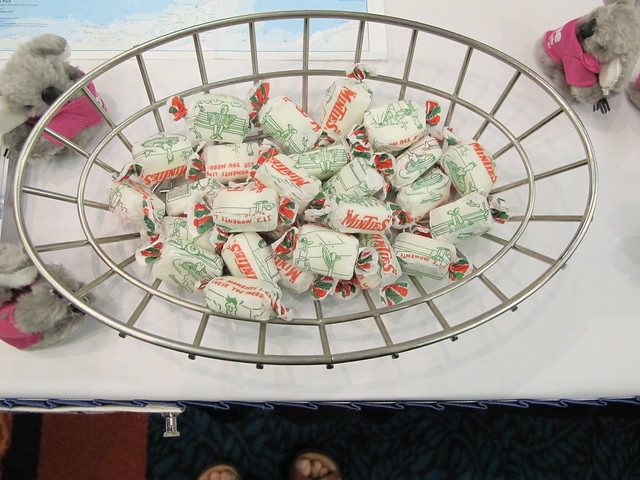
On Saturday morning, I was browsing the booths in the exhibit hall, when I spotted an Australian flag out of the corner of my eye. What's that about? As I drew in closer, I saw a table was stacked with all manner of tourism information for Brisbane. Brisbane!? The city in which I was born and bred? Eh? I was so absorbed in trying to figure out why my hometown had its own booth at NATS, I completely missed the basket of lollies to one side. "Mel," asked Matt, "is this Australian candy--?"

MINTIES!!
MINTIIIIIES!!!!

MINTIES!!! I got very excited about these at the ICVT table #nats52

I'm not sure I've ever been so excited about Minties in my life. I hadn't even thought about them in nearly a decade. For confused Americans: Minties are functionally equivalent to Tootsie Rolls, but white and mint-flavored (and Australian, obviously).

It turns out that beloved BrizVegas is the host city for the 2013 International Congress of Voice Teachers next July, and in attendance at NATS were representatives from the Australian Voice Association. I didn't get to properly sit down with them all, but I met the president Jane Mott and had the chance to speak with VP Adele Nisbet, and caught a good case of homesickness talking about mutual friends and haunts. They left me with a bunch of Minties (eating the last one now) and a packet of Aussie flag cocktail toothpicks (expect those to show up at future house parties).

The conference was held at the Renaissance Hotel at SeaWorld, so it seemed natural Matt and I should hang out at SeaWorld on Sunday, especially with discounted tickets. I enjoyed myself more than anticipated, and didn't even mind the Florida heat (Philadelphia was simultaneously in the grips of a heatwave that brought worse temperatures anyway). I sort of forgot that SeaWorld is more circus than zoo or amusement park -- and the animals actually do seem to enjoy performing, although I'm sure PETA would disagree or something. They even have one of those troupes of rescued pets that seem to be all the rage at the moment, which of course turned Matt and I into insufferable cat idiots squeeing at all the performing kitties.

The biggest squee of Sunday, however, was reserved for a blog comment notification that buzzed my phone in the middle of the seal and sea otter pirate show. One of the highlights of our recent roadtrop was a dinosaur dig we did in Wyoming, and our guide dropped into the roadtrop blog to give us some exciting news about a bone I found at the dig -- see the latest roadtrop entry for details!


Now we're back in Philly. I have parts to create for a new arrangement of Jack and the Beanstalk for the Kennett Symphony, and a crapload of laundry to fold. Sigh.

Wednesday, June 27, 2012

in a composition hole don't try to talk to me

I'm trying to wrest myself away from an arrangement I'm doing of one of my pieces. The reason I'm always putting off composing is that when I start, it takes up everything. All my physical space, all my mental space, all my energy ... I forget to eat and sleep, I don't want to talk to anyone, and even when I'm forced to pull back (as I'm forcing myself to now, for my own health), all I can really think about is how I need to get this composition finished.

You know what? I don't care how bad MIDI instruments sound (and WOW have they come a long way since I ditched writing music on paper 16 years ago), I freaking love playback. No amount of sneering from composers who think we young 'uns rely too much on it will counteract the inherent coolness of being able to say, "Hey, slave robot orchestra inside my computer, now play this! Wait, now try THIS!"

Yeah, I guess I could still compose without playback, but I'm really bad at remembering to put in accidentals, probably because I grew up singing fixed do. And besides, the less pressure I put on my underslept malnourished brain, the longer I can go without sleeping or eating. Win-win.

Saturday, June 23, 2012

Tesla's Pigeon takes flight

Wait, maybe that headline isn't cheesy enough.

Judges coo over Tesla's Pigeon
Audiences flock to hear Tesla's Pigeon
Composer a-flutter at song cycle's success
Tesla's Pigeon not just a load of guano


Visit the Tesla's Pigeon microsite
for further information, artwork,
merchandise and more.


I'm excited to report that Tesla's Pigeon has won the National Association of Teachers of Singing 2012 Art Song Composition Award. This week, they're flying me down to Orlando's Renaissance Hotel at Sea World for the NATS 52nd National Conference to collect the prize and see a live performance of the song cycle at a recital on Saturday, June 30, at 3:30PM. Matt's coming too -- I picked up a South West Airlines credit card a couple of months ago, preloaded with enough points to seat him next to me for free. I'm so happy that this piece is getting some recognition; I believed in it enough to hire the marvelous, gorgeous, adorable soprano Jessica Lennick and the dashingly talented and accomplished pianist Tim Ribchester -- both of whom are always my first choice for anything involving voice and keyboard -- to record it last year (available on bandcamp, as well as Amazon and iTunes), and aside from the glory of winning, it's a relief to finally be able to break even on that enterprise.

Aside: This isn't the first decent prize I have won in a competition that levies an entrance fee. I sort of feel obliged to put that out there because I have read more than one opinion article from composers jaded by the competition circuit who categorically denounce entrance fees and advise other composers to never pay to enter competitions because they themselves have invested small fortunes over the course of their careers with no payoff. Indeed, most competition listings provided by services such as the American Composers Forum or the American Music Center clearly demarcate or separate contests with fees to facilitate composers with this attitude. Community discussion about entry fees reached fever pitch back in 2010 when Eighth Blackbird (whom I adore) launched its first competition; they decided to remove the imposed $50 entry fee after a storm of criticism. I was right on the fence about that one. I think if they had originally charged $20 or $30, there wouldn't have been an outcry, but -- I think because of the existence of the $50 bill, an annoying denomination that businesses often refuse to accept -- psychologically, $50 feels even more exorbitant than it is. And make no mistake, it is exorbitant. But I'm not anti-fee in general. I think it takes a lot of time and effort to run a competition, and a lot of the small private organizations that run them wouldn't be able to offer any prize money without fees. At least for me, the presence of fees causes me to filter my entries. Is this composition really worth the $100 I might spend sending it out to a few contests? Does it have a chance, or is it one of those pieces that probably nobody in the world is going to like as much as I do*? Plus, of course, I can't speak out against fees with any verisimilitude because I've made quite the return on my investment. Is it worth entering composition contests with fees? Well, yeah, sure it is, if you win.

Tesla's Pigeon will hopefully get some attention the following weekend as well: July 7 through 9, I have been invited to take part in the Tesla birthday celebrations and conference organized by the Nikola Tesla Club here in Philadelphia, so I'll be selling CD's, scores, and the remaining silkscreen prints in addition to my speaking and hosting duties. If you're interested in checking out the event (and you should be), I highly recommend the Divine Hand Ensemble concert on the evening of July 7. Divine Hand are a Theremin + strings ensemble I befriended two Tesla's birthdays ago; I interviewed each member of the group on camera last year for a documentary about their inception called 21st Century Classical Music, which I believe is scheduled for broadcast later this year (more details when I have them). Here's an excerpt about their annual Halloween concert, featuring music from the Ghostbusters score by Elmer Bernstein:


So come hear some Theremin arrangements and originals, and say hello and maybe pick up a Tesla's Pigeon CD (even though CD's are practically artifacts at this point) or silkscreen print from me after the show (or, you know, get one now online by clicking on those links):

Awards Ceremony & Concert
Featuring: The Divine Hand Ensemble

R.U.B.A. Hall
414 Green Street, Philadelphia
Tickets $12

*I love those pieces. I send them out sometimes, but nobody or hardly anybody is interested in playing them, so they mostly just sit in a drawer. I get them out every now and then and say to them, "I love you. Don't let rejection get you down. I wrote you because you are cool and you'll always be cool to me." I am a great mother.

Monday, October 17, 2011

Karlheinz Stockhausen and David Icke, sitting in a tree ...

A few moments ago, I was mining a 1977 interview with Stockhausen for quotes and insights to include in a horrible paper I'm writing on Mantra that is already late because I am allergic to writing it. Anyway, I tweeted:

Hahaha, right? then, OH HOLY SHIT, this on the last page of the interview:
The spirit of [my latest work Sirius] is that it is music from Sirius, which is transposed on this planet and [reveals] the possibilities of this planet, because I think that the culture of this planet has been mainly formed by visitors from Sirius, especially in the time between 9000 and 6000 B.C., [as have] most of our modern concepts of cultural achievements, as far as these are still available, because, as you know, an enormous amount has been burned in the library of Alexandria, where all the secret knowledge of architecture, of mathematics, of astronomy and of the arts, and of the magnetism of the earth, of ecology, etc., has been destroyed voluntarily by the Christian orthodox administration. But I think that our main sources of present-day culture, as decadent as it may be in most parts of the planet, stem from visitors from Sirius whose main representatives (leaders) were Isis and Osiris. Through a series of revelations which were at first quite nebulous, but have become more clear during the past few years, I know (as little as I know about details) that I have come from Sirius, myself. And I know that the highest kind of language that can exist for this highly developed culture is music. As long as we're inclinated toward the bodies and possibilities of the body of this planet Earth, then everything from Sirius appears as music. It is structured in a direct harmony with the forming principles of the universe, of the rotations, of the seasons, of different aspects of youth, man, woman, the friend, of the elements earth, fire, water, air, of states of growth, etc. All of these characteristics stem basically, and have been made conscious, from this culture, and there are many other planets which have been influenced by these universal principles, which are communicated best through sound in music that is the best and most universal way.
KARLHEINZ STOCKHAUSEN IS AN ALIEN, YOU GUYS.

WHY AM I WRITING THIS PAPER.