Showing posts with label psychobabble. Show all posts

Tuesday, April 29, 2014

The worst part of composing

Everyone has their own damn hell to push through, but here's mine: after months, nay, years, of feeling creatively kind of constipated (refer to multiple posts about depression on this very blog), I go back to a theme I smeared on the page maybe a year ago, and I hate it. It's supposed to be a twisted love theme. It's shit. It's a turd that I have tried multiple times to polish, but all it does is smear into ever more bland and messy stains. I decide to scrap the entire theme and do the whole damn thing over, which is going to affect a bunch of other moments and scenes, but whatever; they're all shit, contaminated by the stink of this stupid theme. They all need to be rewritten. In fact, most of the scenes in question need to be written, never mind the re-, so who cares; I may as well start over. After hours of staring at the newly blank staves while too afraid to move, I finally write a different theme. I think it's better, but I'm not sure. I worry that I'm second guessing this brand new theme. But then, I was second guessing myself by scrapping and rewriting the original theme, so actually, this is at least the third guess. I'm starting to think everything is a damn guess, and none of the guesses are close to the mark.

Sometimes I really wish I could trust myself. But if I do, and the result is a giant smear of excrement, well, that won't do at all, will it?

In conclusion, I hate everything.

Friday, January 03, 2014

Being depressed: a really boring non-epic saga about a really boring problem

As I've mentioned on this blog a couple of times, I suffer from depression.

BOOOOOOORIIIIIIING.

Really, it is, though. It is fucking boring and annoying. I suppose one expects depression to be a little more dramatic than it is. But what I have is not even slightly dramatic. For example, I am able to be base-line functional most of the time. I am not suicidal. I suppose I have had thoughts about simply "not existing" occasionally, but that is a very passive thought and a long way from suicide. (I can understand how some people suddenly become suicidal when starting depression meds and passivity yields to activity, however.) Also, I don't do things like self-medicate with alcohol or illegal drugs, I don't have psychotic breaks (one time I had a weird and very brief dissociative episode, but that might be a PTSD thing), and I haven't yet become a hoarder.

Here are some things that my depression has caused:
  • anhedonia, oh god, so much shitty, shitty anhedonia
  • feeling like I'm thinking through a fog
  • headaches
  • hating nearly everything I have ever composed
  • hearing something I have composed that I do like, and being convinced that I have no idea how I did it and will never write like that again
  • sleeping/waking inertia i.e. sleeping for 15 hours sometimes because I can't be bothered waking up; staying awake until 5AM sometimes because I can't be bothered going to bed
  • not being able to read more than 10 pages of a book at a time without falling asleep
  • exhaustion after any kind of social interaction
  • not wanting to talk to anyone, even nice people
  • not wanting to answer any e-mails, even good ones
  • horrible anxiety when compelled to engage in unpleasant communication
  • horrible anxiety when compelled to make a decision, even about unimportant things
  • not wanting to leave the house
  • sitting in my underwear watching bad television for days on end
  • getting overly emotional about bad television while being unable to feel anything about my actual life
  • realizing that all my depressive symptoms are irrational and indicative of something being wrong with me, and loathing myself for being unable to think in a way that isn't irrational and wrong
Here are some things I have done in an attempt to get better:
  • Prozac (awful, nearly cost me my marriage)
  • therapy (helpful, I really like my therapist, though the depression persists)
  • meditation/yoga (not helpful; kept falling asleep)
  • Wellbutrin (speedy as hell and helpful at first, although it caused me to lose 10% of my body weight despite shoveling cheeseburgers and lard pastries into my mouth in between venti caramel macchiatos with whipped cream; then it kind of stopped working so well and the anhedonia came back)
  • vitamins (all the vitamins, but especially D and fish oil; no tangible effect at all)
  • gluten-free diet (no physical or mental effect, except I missed bread too much)
  • light therapy (fairly helpful)
  • Cymbalta (is it working? I honestly have no idea)
  • removed NuvaRing and went off any hormonal birth control for the first time in 16 years (may be helping, not 100% sure yet)
Recently I realized the "not wanting to leave the house" symptom has led to me becoming the most skinny-fat person in America, especially since I am ABD and internet-savvy and thus don't actually have to leave my house, ever. So I am thinking about taking up kung fu again. (I used to do it a long time ago in Harrisburg before I got overwhelmed and quit in a sort of cowardly way when my dad died. Probably a depression precursor or something.)

A few weeks ago, I messaged my friend who is going to a kung fu place near me. Writing a message = huge step. Today, I visited the kung fu place while Matt and I were in Chinatown for lunch. I know, crazy; I left the house. They weren't open, but I am pretty proud of myself for going up to the door and looking at the photos posted outside. What an achievement. My ultimate goal is to one day walk in while they are open and speak to the sifu about attending. I have a lot of anxiety about that. It's a depression thing. I guess. I hate myself.

Here's to 2014!

This is what I looked like when I did kung fu years ago.
Just looking at this makes me feel kind of hopeless.

Tuesday, June 18, 2013

Marital bliss

(Yeah, I didn't blog for a few weeks, and now all the bloggable items in my head are stacked up in overflowing piles like the contents of a hoarder's house. I have some composition-related news stuff, but I'll save that for another day.)

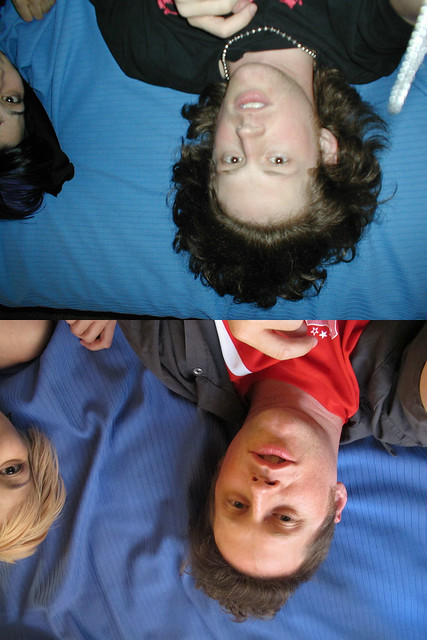
Last year, to celebrate the tenth anniversary of falling in love, Matt and I went back to New Orleans and recreated a bunch of our goofy snapshots from 2002.
I have been married to my incredible, amazing husband Matt for nearly ten years. Ten yeeeeears. Good god. He ought to get a medal. Recent planning of our anniversary celebration has reminded me just how unusual our situation is among our peers, many of whom are only getting married now, a decade behind us. We, on the other hand, were more or less children; when I hear about people in their early twenties getting engaged, my first reaction is always, "That's so young!" before I realize that we were only 23 when we took the plunge. ["You Know What Turns an Unstable Relationship into a Stable One? Not a Wedding Ring."] It was different for us, though. We had to get married just to give our relationship a chance because we lived on different continents. Before I met Matt, acquiring a husband was never a priority. I was even slightly averse to marriage as an unnecessary institution. Matt and I still laugh to remember our attitude when we got engaged: Honey, I love you so much, I will even marry you if that's what it takes. But against all the odds and no doubt many expectations, our relationship, sealed by wedding vows, has been and still is the most wonderful thing ever, and the most important thing in my life; together we have gone on the coolest adventures, worked on insane projects, weathered disastrous emotional crises, grown closer and grown up (and we continue to grow), and never stopped being best friends. It sounds wretched cheesy when I type it out, but it's true.

We also haven't had kids, and neither of us are really looking to have any in the near future, which is another thing that sets us apart from most people we know. This has been on my mind lately too — ten years ago, when I similarly felt no maternal urges, I figured that if I were ever to change my mind, it would be around now. I check myself ever other week, wondering if the desire to procreate is down there somewhere, hiding under my guilt for avoiding the cat litter perhaps, but I can see no sign of it. I'm happy with my life. I'm working through an annoying depression that has hung around for a few years, but my external life is terrific. I feel no need to change it by introducing a child into it, and I don't think a child would improve it. And I like kids. I really do. What can I say? Jesus suffered the little children, and he didn't have kids either.

Mmmmmm. Cake.
Anyway, for our tin anniversary in September, we're throwing a big party and playing some live music as Up Your Cherry for our friends and family. There will be some guest stars too — Jess Lennick and I are possibly pairing up to present an Ayn-themed duo, Inverse Phase might be spinning some tracks, Jordan Smith of Tears for Agnes might be flying in from Japan, and Matt's been jamming with a few of his friends from work who may or may not be ready to play out by then. So far we've decided to hold it at PhilaMOCA, which is right down the road from our house, and we're thinking of asking our favorite neighborhood restaurant Honey's Sit 'n Eat if they'll provide catering (so local! hipsters++!). I also need to find a good cake source. Can't have an anniversary party without cake. For our wedding, we did multiple cheesecakes: plain, white chocolate, strawberry, and Snickers. It may have been the best part of the day.

I'm really excited about all this because planning fun things with Matt is, well, fun, and it gives us (me, mostly) a reason to devote a bunch of time to writing and rehearsing Up Your Cherry songs too. It's difficult right now for me to set aside time for UYC because I have the pressure and weight of an unfinished dissertation opera forcing itself downward on my mind and forming some pretty gnarly guilt diamonds.

Another handy spousal nice-time distraction from the opera is the redesign of my website(s), which I'm pushing forward from later this summer because some horrid evil scripty nonsense has somehow been injected into various pages of my current site(s), and it's easier to nuke it all from orbit now than clean it up knowing that I'd soon be changing everything anyway. I bounced some ideas off Matt this past weekend, and I'm excited about the new format I want. This week I'm going to do some freeform design brainstorming on my own (it's actually more like scrapbooking) and hopefully come up with some mockups in Photoshop for Matt to begin to implement. I'm so grateful he's not only very able, but apparently willing, even though this is technically work for him. Every time I come back to website coding after a hiatus, I am a cross-eyed idiot, and it takes forever to get my bearings. I used to make a point of relearning everything I'd forgotten and being extremely hands-on in the implementation process, but I've realized that's just me being a stupid control freak and having a chip on my shoulder about needing to know how to do everything for myself. If I never delegate, NOBODY CAN BE BETTER THAN ME AT ANYTHING EVER!!111! LETTING OTHER PEOPLE DO THINGS FOR ME IS EVIDENCE OF INCOMPETENCE!!11!!!!!11!!!! Thanks for that value, Mum, real helpful.

Last thing: a couple of weeks ago, Matt and I headed west to our old stomping region, Central PA, to attend the premiere of No Sanctuary, a fun film project I acted in back in 2005. Jake Stetler, the film's director, has been editing together the film whenever he's had the opportunity over the past eight years, and he was proud to be able to show it to an audience of friends and family at Ephrata's Main Theater. Our friend Kendall Whitehouse showed up as paparazzo:
 
No Sanctuary: Jake StetlerNo SanctuaryNo SanctuaryNo Sanctuary: Jake StetlerNo Sanctuary: Jake StetlerNo Sanctuary: August and Jake Stetler
No Sanctuary: August, Jake, and Kaden StetlerNo Sanctuary: Jake StetlerNo Sanctuary: Jake StetlerNo Sanctuary: Jake StetlerNo Sanctuary: Michael Shoupe and Katy StettenbauerNo Sanctuary: Melissa Dunphy and Katy Stettenbauer
No Sanctuary: AJ Ensminger and Katy StettenbauerNo Sanctuary: Fred Waters Jr. and Katy StettenbauerNo Sanctuary: Sarah Treusdell and Katy StettenbauerNo Sanctuary: Joseph Salaki Jr. and Katy StettenbauerNo Sanctuary: Jake Stetler and Gail StetlerNo Sanctuary: Stan Roache III and Katy Stettenbauer
No Sanctuary: Larry Snyder and Katy StettenbauerNo Sanctuary: Kelly Stettenbauer and Katy StettenbauerNo Sanctuary: Kyle Kreider and Katy StettenbauerNo Sanctuary: Brandon Ehrhart and Katy StettenbauerNo Sanctuary: Katy Stettenbauer and Dan FisselNo Sanctuary: Kevin Sharp and Katy Stettenbauer
Via Flickr: Cast, crew, and investors attend the premiere screening of Jake Stetler’s No Sanctuary 
at the Main Theater in Ephrata, PA on May 24, 2013.

Friday, May 03, 2013

I am a woman. I am a composer. I am a woman composer.

Being a female composer is weird for the simple reason that there aren't very many of us and we aren't all that visible. (Being a female composer of color is even weirder.)

I've been calling myself a composer for about six years now, and over that time, I've become more and more conscious of my gender, and to a lesser degree, my ethnicity. Maybe at first I was just so narcissistically excited to think of myself as a composer at all that I didn't notice my colleagues' background. Once I started taking notice, however, it became a game at new music concerts to survey all the composers forced to take those terrible awkward bows from the audience after their pieces have been performed (God, I hate taking those bows). And the result?

The vast majority of composers are white men of average build with brown hair and glasses.


I don't have a scientific survey, but a tally of the people around me suggests that this majority is upward of 80%. Sometimes gaggles of composers look so similar that I can easily imagine they are all siblings in some incredibly musical quiverfull family whose father only shoots Y-chromosome sperm.

Some composers are older and their brown hair has turned grey or white, and sometimes they wear contact lenses instead of glasses, but for the most part, this stereotype is confirmed over and over again. Very occasionally the composers are Hispanic or Asian, but they usually retain the characteristics of maleness and having average build and brown hair and glasses.

I'm not saying that there is anything wrong with being an average-looking white guy with brown hair and glasses. They're not actively oppressing anyone just by being who they are. Nobody who fits this description should have to feel guilty about it. And obviously there are exceptions to this rule. But the stereotype applies to the point where I'm often left giggling at its absurd ubiquity.

So what the hell does this mean? We live in a world brimming with all kinds of gender (and racial) equality now, right?* Why aren't there more female composers around? Are the institutions sexist? Are the judging panels of composition contests and the programmers of concert series sexist?

I don't think they necessarily are, or at least, I don't think that's the real root of the problem. Institutions, judging panels, and programmers just exist in a world where the vast majority of all composers are already white men of average build with brown hair and glasses, and that majority isn't changing very quickly. How can you demonstrate equality between the sexes in any concert series when maybe one in ten composers out there are women?** You can't just pluck women at random from the street and ask them to compose some art music. It takes years of training, and of course, they have to want to do it in the first place.

And thus the problem is perpetuated because the example is very firmly set for younger generations: "Hey, kids! Composers look like white guys with brown hair and glasses. They've looked like this for 600 years, and they look the same way now."

When you're a child, you absorb all kinds of things about gender from the moment you start interacting with the world. Men are heroes, and women are princesses to be won. Men are doctors, and women are nurses. Alpha-male businessmen have ultra-feminine secretaries.

Quick: picture a firefighter. He's a man, right?

Quick: picture a professor. If you didn't think of an old white guy, you are a very unusual person.

Quick: picture a kindergarten teacher. If you didn't picture a woman, you are again a very unusual person.

I've worked with little kids a fair bit as a theater/acting educator, and something I notice about them is that you very rarely meet a little boy who wants to be a nurse or a teacher when he grows up. For whatever reason, little boys have been socialized to think of these jobs as unsuitable for them. You also don't find a lot of little girls wanting to be pilots or engineers or firefighters. Of course, when they grow older, they sometimes learn that these traditionally gendered careers are open to them after all, and they occasionally follow those paths. But still, over 90% of registered nurses are female. Over 80% of engineers are male.***

Now ask a musically literate child to think of ten composers. If she can name that many, how many do you think will be women? How many of the compositions that child has learned to play do you think are by women?

Knowing this, how many little girls do you think might want to be composers when they grow up? How many little girls even realize they can be composers? How many have even had the idea?

Maybe, just maybe, there's a reason that, despite being a musician all my life, I didn't even think about becoming a composer until I was 24, and I didn't call myself one until I was 26.

(Related: how many black children do you think want to be art music composers when they grow up? Funny story: like every other clunky-fingered beginner pianist, I learned The Entertainer as a child, but I am horrifically ashamed to admit I only found out last year that Scott Joplin was black. The internet didn't exist when I learned The Entertainer, I'd never seen a picture, and nobody ever mentioned to me that he was black, so by default, I had always pictured him as a white guy (probably wearing a boater hat). Shocked and mortified by my own ignorance, I informed my husband how dumb his wife was, and he had to admit that, until that moment, he also had not known that Scott Joplin was black, despite learning about ragtime in high school music class. Nobody had told him either.)

One of the pressures that I feel as a woman composer is my own desire to demonstrate to future generations of little girls that composers aren't just white men with brown hair and glasses. Even though most of them still are. The only way the demographics are going to change is if we go in at the ground level. We need young girls and boys to see that composition is not a gendered pursuit, not just by telling them so, but by showing them. We need a Girls Rock Philly organization for classical music — or maybe there would be a way to fit classical music into their mission? I don't know — I haven't approached them, though I absolutely love what they do. I really want to volunteer with them once my schedule allows i.e. after Ayn. I want to start a composition school for girls.

Maybe I'm doing myself no favors, but I don't feel it's enough for me to exist as a composer and forget about the "woman" part. I personally feel an obligation to be more visible if I can be, to make up for the fact that I'm such a minority, so that it's not such a fucking embarrassment to new music that all the composers taking a bow look exactly the same. With the situation as it is, women composers need to shine brighter than their abundant male counterparts so that eventually, one frabjous day, so many aspiring girls will take our place that we will be able to forget about the "woman" part. That day has not arrived. Yeah, this is problematic; that's a lot of pressure to place on current women composers. It makes things unequal for us. It contributes to the sense that in order to make it, we have to work twice as hard. It confirms the idea that the default majority can make it as individuals, but minority artists are forced to represent their entire group. But I'd rather do that than pretend there isn't an imbalance and do nothing, which is about as useful a solution as calling myself George and wearing a top hat. ("Hey kids! Composition is such a male pursuit, I had to become a man in order to do it!")

(Tangentially related: I think it would be really interesting to study how the demographics of forensic scientists, particularly forensic pathologists, have changed since the 1980's. I've mentioned this before: I watch a lot, I mean a lot of television detective shows, particularly police procedurals, and it seems like virtually every TV forensic pathologist is a woman now. I enrolled in med school in 1997 only because I wanted to be a forensic pathologist (and quit when I realized there weren't enough jobs in Australia in that field); I have no doubt now that this desire was in part inspired by The X-Files and Patricia Cornwell, and there are even more fictional examples of female FP's now. Has fictional representation in the media done anything to affect gender distribution in forensic pathology more than other medical fields? I'd be so curious to know.)


I am woman, hear me ... make woman music

Here's a confession. When I first decided to become a composer, I bristled at the idea that I was a "female composer." I felt there was a stereotype about the kind of music that a female composer would write, and I didn't want to fit that mold. What can I say? I hadn't really thought deeply about the reasons behind my views. I had just finished a long fling with industrial music, which is deeply gendered and whose fans can be quite sexist when explaining their musical preferences ("I don't like female-fronted bands."). I wanted to make it in a man's world writing MANLY MALE MUSIC like all those MAN COMPOSERS I had admired all my life. The ultimate expression of (second-wave) feminism, right?

Of course, this brings up a huge, touchy question. Do female composers and male composers write different kinds of music? I don't claim to have any kind of definitive answer. We are almost certainly socialized very early on to believe that there is some level of gender differentiation in music. Society still tends to squeeze everyone and everything into categories of feminine and masculine. Boys are given trucks to play with and encouraged to listen to loud tough music. Girls are given dolls to play with and encouraged to listen to pretty soothing music. By the time you reach middle school, there are at least some boundaries set, sad as they may be. A boy would probably catch hell for being into female pop bands. A girl is flying a tomboy flag if she's into heavy metal. A lot of children start throwing around slurs when they see peers not behaving in a strictly heteronormative way. Children learn to conform, no matter how much we ask them to be brave.

I brought this discussion up on a Facebook thread the other day, and a friend made a comment that got me thinking:
But do you find it worth exploring, like an evolutionary psychologist might, whether there are some maybe biological underpinnings for the different sorts of music they're likely to write and play?
My first impulse was to yell NO!! We are all forced to conform! We're all the same deep down! But then I wondered. And I remembered: biologically, women and men do perceive things differently. Take color. Women see more yellow in green and more red in orange than men do. Far more men are colorblind, but now we've discovered that some women are tetrachromats and see 100 million more colors than men. Where sound is concerned, women have a faster and more negative reaction to a baby's cry than men, to encourage/force them to look after their squalling young (a nasty evolutionary trick that helps explain why I become highly anxious on airplanes when a baby starts screaming, while Matt takes it perfectly calmly). Along the same lines, men and women have very different sensitivities to sounds, at least when sleeping. A crying baby is the sound most likely to wake a woman. The sound isn't even in the top ten for men, who are more likely to react to a car alarm.

If our senses are calibrated differently, wouldn't that have some kind of influence on our artistic taste? What kind of influence? (Maybe I don't like some types of dissonant music because they sound too much like babies crying? she ponders facetiously) It's a very complicated question, and any answer would be less than universal. But I have to wonder: if there were more women composers, would art music sound different? At some level, do women feel, like I once did, that they should make an effort to write like men, because male composers set all the examples we study in school?

Maybe these are stupid questions. I don't know. All I know for sure is that, six years ago, I had internalized some horrible idea that my music shouldn't be too "feminine," whatever the hell that means, because somehow "feminine" was bad. "Feminine" wouldn't be taken seriously enough by the art music world. People would roll their eyes and dismiss me as a wishy-washy woman composer. I hate that I held this attitude. It wasn't something at the forefront of my mind, I didn't express it in any overt way, but it was there. Ugh ugh ugh.

So here it is. I am a woman composer. I don't set out to write "feminine" music, but if anyone were to find it feminine, including myself, fine. Good. We have had 600 years of music written by men, 600 years of being told that that is what art music is. If—if—our music is different in any way, we shouldn't shy away from that. We shouldn't deny our gender.

And if we write "masculine" music, that's good too. But it's not better.

Maybe I'm the only person in the world to have internalized these ideas to the point where I have to talk myself out of them in a therapeutic blog rant. I doubt it, though.

*Hahahaha.
**Without affirmative action, that is (OOGER BOOGER).
***Not even getting into women of color here because it's too depressing.

Thursday, January 03, 2013

Orchestrating Tesla's Pigeon

I've been talking idly about arranging Tesla's Pigeon for orchestra for a long time. Ever since writing it, I've clearly known which instruments are supposed to be playing each line. Maybe this has something to do with what a crap pianist I am; even when I'm writing for piano, I'm not really writing for piano.

Anyway, I started by sitting down this weekend with this awesome score of the Ravel orchestration of Mussorgsky's Pictures at an Exhibition that I found in my room. I have no idea how it got there -- did someone give it to me? Did I buy it one day knowing I'd need it? At any rate, I pulled it out along with the piano score, only to discover that BY GOD these Eulenburg geniuses have included the original piano in the orchestral score for reference. Modern convenience. So great. Thank you, whatever unseen force put this score on my shelf.

The solstice is past, and I can feel my body and brain slowly turning toward the spring and seeing light at the end of a seasonally depressed tunnel. It's been a nasty slump this winter. The one "good" thing about depression is that it sometimes precipitates very intense emotional reactions -- to music, for example. So long as I'm not out in public or trying to drive straight, I appreciate them. I listened to Pictures at an Exhibition by myself with my handy Eulenburg Edition score on Sunday, and by the time I walked past the Great Gate of Kiev, I had completely lost it. I was literally sobbing. Sobbing! I mean, sure, I love that piece. I played it with QYO back in the day, and most of the pieces I played in my mid-teens made a huge impression. But: heaving sobs ... I haven't had that happen during a piece since I accidentally caught the Alpine Symphony on NPR back in 2008. Funnily enough, I played that with QYO too. Probably something to be said about that.

God, Ravel is good.

My hope is that I will have it orchestrated by the time school starts next week, and that the Curtis Orchestra will read it this semester. With Jess Lennick on pipes, naturally. I've made a cracking start: all the main stuff has been parceled out to the appropriate instruments, and now I just have to embroider. Oh, and create parts, I guess. Ugh.

I am heading to bed with this Eulenberg score. It's even a convenient bed-reading size. Such a fan.