Showing posts with label culturobabble. Show all posts

Sunday, July 13, 2014

L-O-L-A Lola la-la-la-la Lola; or What is my culture?

I started writing this post at the Eugene O'Neill Theater Center in Connecticut last month, where I was the very happy music composition director for the 2014 National Puppetry Conference, surrounded by dozens of deliciously creative and crafty people. For eight days, I found myself with more energy and confidence than I had felt in a very long time — a common effect of the O'Neill — although that boost might also have been left over from a sudden storm of inspiration and discovery I had a few days before I left Philly, after months of compositional drought.


Performing (on my new Luis & Clark viola) at the O'Neill showcase. Photo by Richard Termine.

Frustrated with Ayn that week, I decided I might as well set myself a short composition exercise to help open the sluices, the sort of thing I used to do back when I was in coursework. The task: to write a short and relatively easy work for SSAA chorus in response to a competition call from the Twin Cities Women's Choir. The deadline: three days. Step one: find a decent text.

Friday, January 24, 2014

Perform disturbing gender experiments on yourself

I've written before on this blog about being a woman composer. In case it isn't blindingly obvious to everyone who stops by, I'm a proud feminist, and being part of the struggle for equal rights and equal respect for people of different genders, races, and sexualities is one of the things I am proud and happy to do with my life.

Something that has always bugged me is the way the Western human brain, as it's currently encultured, is pretty bad at judging quantitative equality. In smaller words: our society is so geared towards white men that we have trouble noticing when minorities are underrepresented. Most of us can look at, for example, a room full of American Congressmen and not feel particularly concerned that it is only 18% female.

This has been reported most recently thanks to the efforts of Geena Davis (who is the fucking bomb). She has established a whole institute devoted to gender in media whose job it is to point out uncomfortable truths such as: only one-third of speaking roles in films are for female characters. So for every woman speaking, there are two men. One of the statistics she highlights is particularly fascinating:
Crowd scenes [in films] are only 17% female; one study found that men have come to perceive that 17% ratio as 50/50.
As I mentioned in my previous blog post, I sometimes feel that women in music are lost in a sea of men (with brown hair and glasses). I feel a responsibility to be more visible to set an example and make up for the fact that there are so few women writing new art music. The trailing edge of that visible sword is that once the number of women reaches about 17%, a lot of observers—who aren't actually counting, but just looking—will think that equality has been reached. No more to be done here! Women have all the representation they need now, right?

Are you a comfortable feminist? Feel like scaring yourself a little? Next time you find some kind of gender-neutral "list" of people, scan it and try to decide what the percentage of women to men is. I came across this silly list "49 Creative Geniuses Who Use Blogging to Promote Their Art" on the horribly named website "boostblogtraffic.com" [shudder]. Hey, it was linked on a Reddit forum; I was curious who had been included.

http://boostblogtraffic.com/promote-your-art/?inf_contact_key=f17e5f9f8f2d07435fc1d49f899e6d26e3d01ff3702c094e47753161c8719b8d

I scanned through the list very quickly, taking particular note of the musicians. But when I reached the end, I suddenly thought of the statistics on female representation and perception and saw an opportunity to test myself.

Stop. Don't look at the list again for a minute. Did you feel that women were well represented? Yes, I thought to myself. It ... it seemed pretty even, didn't it? I began dreaming up a theory that perhaps women, being members of traditionally the more social gender and the gender which, at least when I was a kid, was prone to keeping diaries, were on equal footing when it came to blogging about their experiences as artists. Certainly, I read blogs by just as many women as men, don't I? Don't I? Amanda Palmer! That's who I immediately think of when I consider artists who have used their blogs to connect with their audiences. She was on the list, of course. And there were lots of other women there too, from many different disciplines. There were even some women of color. The leading picture was even a ... clown woman with a megaphone (that's an analysis for another day). So it must have been fairly close to even.

OK, time to tally. No cheating.

There were actually 50 people on the list, since one of the entries was a husband-wife team.

Number of women: 18.
Number of men: 32.

SHIT. My heart = on the floor.

It's not quite a 1:2 ratio, but it's close enough.

I am a feminist who considers herself aware of issues of female underrepresentation. But I'm also part of a culture where I have internalized this warped perception, where I see a pie divided into two-thirds and one-third, and I think it's split right down the middle.

Everyone should do this. You have to catch yourself after you look at a crowd, though, to make sure you aren't subconsciously counting. Do it so you understand how far we have to go.

Friday, May 03, 2013

I am a woman. I am a composer. I am a woman composer.

Being a female composer is weird for the simple reason that there aren't very many of us and we aren't all that visible. (Being a female composer of color is even weirder.)

I've been calling myself a composer for about six years now, and over that time, I've become more and more conscious of my gender, and to a lesser degree, my ethnicity. Maybe at first I was just so narcissistically excited to think of myself as a composer at all that I didn't notice my colleagues' background. Once I started taking notice, however, it became a game at new music concerts to survey all the composers forced to take those terrible awkward bows from the audience after their pieces have been performed (God, I hate taking those bows). And the result?

The vast majority of composers are white men of average build with brown hair and glasses.


I don't have a scientific survey, but a tally of the people around me suggests that this majority is upward of 80%. Sometimes gaggles of composers look so similar that I can easily imagine they are all siblings in some incredibly musical quiverfull family whose father only shoots Y-chromosome sperm.

Some composers are older and their brown hair has turned grey or white, and sometimes they wear contact lenses instead of glasses, but for the most part, this stereotype is confirmed over and over again. Very occasionally the composers are Hispanic or Asian, but they usually retain the characteristics of maleness and having average build and brown hair and glasses.

I'm not saying that there is anything wrong with being an average-looking white guy with brown hair and glasses. They're not actively oppressing anyone just by being who they are. Nobody who fits this description should have to feel guilty about it. And obviously there are exceptions to this rule. But the stereotype applies to the point where I'm often left giggling at its absurd ubiquity.

So what the hell does this mean? We live in a world brimming with all kinds of gender (and racial) equality now, right?* Why aren't there more female composers around? Are the institutions sexist? Are the judging panels of composition contests and the programmers of concert series sexist?

I don't think they necessarily are, or at least, I don't think that's the real root of the problem. Institutions, judging panels, and programmers just exist in a world where the vast majority of all composers are already white men of average build with brown hair and glasses, and that majority isn't changing very quickly. How can you demonstrate equality between the sexes in any concert series when maybe one in ten composers out there are women?** You can't just pluck women at random from the street and ask them to compose some art music. It takes years of training, and of course, they have to want to do it in the first place.

And thus the problem is perpetuated because the example is very firmly set for younger generations: "Hey, kids! Composers look like white guys with brown hair and glasses. They've looked like this for 600 years, and they look the same way now."

When you're a child, you absorb all kinds of things about gender from the moment you start interacting with the world. Men are heroes, and women are princesses to be won. Men are doctors, and women are nurses. Alpha-male businessmen have ultra-feminine secretaries.

Quick: picture a firefighter. He's a man, right?

Quick: picture a professor. If you didn't think of an old white guy, you are a very unusual person.

Quick: picture a kindergarten teacher. If you didn't picture a woman, you are again a very unusual person.

I've worked with little kids a fair bit as a theater/acting educator, and something I notice about them is that you very rarely meet a little boy who wants to be a nurse or a teacher when he grows up. For whatever reason, little boys have been socialized to think of these jobs as unsuitable for them. You also don't find a lot of little girls wanting to be pilots or engineers or firefighters. Of course, when they grow older, they sometimes learn that these traditionally gendered careers are open to them after all, and they occasionally follow those paths. But still, over 90% of registered nurses are female. Over 80% of engineers are male.***

Now ask a musically literate child to think of ten composers. If she can name that many, how many do you think will be women? How many of the compositions that child has learned to play do you think are by women?

Knowing this, how many little girls do you think might want to be composers when they grow up? How many little girls even realize they can be composers? How many have even had the idea?

Maybe, just maybe, there's a reason that, despite being a musician all my life, I didn't even think about becoming a composer until I was 24, and I didn't call myself one until I was 26.

(Related: how many black children do you think want to be art music composers when they grow up? Funny story: like every other clunky-fingered beginner pianist, I learned The Entertainer as a child, but I am horrifically ashamed to admit I only found out last year that Scott Joplin was black. The internet didn't exist when I learned The Entertainer, I'd never seen a picture, and nobody ever mentioned to me that he was black, so by default, I had always pictured him as a white guy (probably wearing a boater hat). Shocked and mortified by my own ignorance, I informed my husband how dumb his wife was, and he had to admit that, until that moment, he also had not known that Scott Joplin was black, despite learning about ragtime in high school music class. Nobody had told him either.)

One of the pressures that I feel as a woman composer is my own desire to demonstrate to future generations of little girls that composers aren't just white men with brown hair and glasses. Even though most of them still are. The only way the demographics are going to change is if we go in at the ground level. We need young girls and boys to see that composition is not a gendered pursuit, not just by telling them so, but by showing them. We need a Girls Rock Philly organization for classical music — or maybe there would be a way to fit classical music into their mission? I don't know — I haven't approached them, though I absolutely love what they do. I really want to volunteer with them once my schedule allows i.e. after Ayn. I want to start a composition school for girls.

Maybe I'm doing myself no favors, but I don't feel it's enough for me to exist as a composer and forget about the "woman" part. I personally feel an obligation to be more visible if I can be, to make up for the fact that I'm such a minority, so that it's not such a fucking embarrassment to new music that all the composers taking a bow look exactly the same. With the situation as it is, women composers need to shine brighter than their abundant male counterparts so that eventually, one frabjous day, so many aspiring girls will take our place that we will be able to forget about the "woman" part. That day has not arrived. Yeah, this is problematic; that's a lot of pressure to place on current women composers. It makes things unequal for us. It contributes to the sense that in order to make it, we have to work twice as hard. It confirms the idea that the default majority can make it as individuals, but minority artists are forced to represent their entire group. But I'd rather do that than pretend there isn't an imbalance and do nothing, which is about as useful a solution as calling myself George and wearing a top hat. ("Hey kids! Composition is such a male pursuit, I had to become a man in order to do it!")

(Tangentially related: I think it would be really interesting to study how the demographics of forensic scientists, particularly forensic pathologists, have changed since the 1980's. I've mentioned this before: I watch a lot, I mean a lot of television detective shows, particularly police procedurals, and it seems like virtually every TV forensic pathologist is a woman now. I enrolled in med school in 1997 only because I wanted to be a forensic pathologist (and quit when I realized there weren't enough jobs in Australia in that field); I have no doubt now that this desire was in part inspired by The X-Files and Patricia Cornwell, and there are even more fictional examples of female FP's now. Has fictional representation in the media done anything to affect gender distribution in forensic pathology more than other medical fields? I'd be so curious to know.)


I am woman, hear me ... make woman music

Here's a confession. When I first decided to become a composer, I bristled at the idea that I was a "female composer." I felt there was a stereotype about the kind of music that a female composer would write, and I didn't want to fit that mold. What can I say? I hadn't really thought deeply about the reasons behind my views. I had just finished a long fling with industrial music, which is deeply gendered and whose fans can be quite sexist when explaining their musical preferences ("I don't like female-fronted bands."). I wanted to make it in a man's world writing MANLY MALE MUSIC like all those MAN COMPOSERS I had admired all my life. The ultimate expression of (second-wave) feminism, right?

Of course, this brings up a huge, touchy question. Do female composers and male composers write different kinds of music? I don't claim to have any kind of definitive answer. We are almost certainly socialized very early on to believe that there is some level of gender differentiation in music. Society still tends to squeeze everyone and everything into categories of feminine and masculine. Boys are given trucks to play with and encouraged to listen to loud tough music. Girls are given dolls to play with and encouraged to listen to pretty soothing music. By the time you reach middle school, there are at least some boundaries set, sad as they may be. A boy would probably catch hell for being into female pop bands. A girl is flying a tomboy flag if she's into heavy metal. A lot of children start throwing around slurs when they see peers not behaving in a strictly heteronormative way. Children learn to conform, no matter how much we ask them to be brave.

I brought this discussion up on a Facebook thread the other day, and a friend made a comment that got me thinking:
But do you find it worth exploring, like an evolutionary psychologist might, whether there are some maybe biological underpinnings for the different sorts of music they're likely to write and play?
My first impulse was to yell NO!! We are all forced to conform! We're all the same deep down! But then I wondered. And I remembered: biologically, women and men do perceive things differently. Take color. Women see more yellow in green and more red in orange than men do. Far more men are colorblind, but now we've discovered that some women are tetrachromats and see 100 million more colors than men. Where sound is concerned, women have a faster and more negative reaction to a baby's cry than men, to encourage/force them to look after their squalling young (a nasty evolutionary trick that helps explain why I become highly anxious on airplanes when a baby starts screaming, while Matt takes it perfectly calmly). Along the same lines, men and women have very different sensitivities to sounds, at least when sleeping. A crying baby is the sound most likely to wake a woman. The sound isn't even in the top ten for men, who are more likely to react to a car alarm.

If our senses are calibrated differently, wouldn't that have some kind of influence on our artistic taste? What kind of influence? (Maybe I don't like some types of dissonant music because they sound too much like babies crying? she ponders facetiously) It's a very complicated question, and any answer would be less than universal. But I have to wonder: if there were more women composers, would art music sound different? At some level, do women feel, like I once did, that they should make an effort to write like men, because male composers set all the examples we study in school?

Maybe these are stupid questions. I don't know. All I know for sure is that, six years ago, I had internalized some horrible idea that my music shouldn't be too "feminine," whatever the hell that means, because somehow "feminine" was bad. "Feminine" wouldn't be taken seriously enough by the art music world. People would roll their eyes and dismiss me as a wishy-washy woman composer. I hate that I held this attitude. It wasn't something at the forefront of my mind, I didn't express it in any overt way, but it was there. Ugh ugh ugh.

So here it is. I am a woman composer. I don't set out to write "feminine" music, but if anyone were to find it feminine, including myself, fine. Good. We have had 600 years of music written by men, 600 years of being told that that is what art music is. If—if—our music is different in any way, we shouldn't shy away from that. We shouldn't deny our gender.

And if we write "masculine" music, that's good too. But it's not better.

Maybe I'm the only person in the world to have internalized these ideas to the point where I have to talk myself out of them in a therapeutic blog rant. I doubt it, though.

*Hahahaha.
**Without affirmative action, that is (OOGER BOOGER).
***Not even getting into women of color here because it's too depressing.

Monday, October 01, 2012

What the hell kind of music does Richard Halley write, anyway?

Last week I read Atlas Shrugged, and I have so, so many things to say (or rather "scream" as EVERYONE IN THE BOOK DOES, CONSTANTLY) about so, so many things, but as a composer, I wanted to point this one out in particular.

There is, remarkably, a composer woven into the narrative named Richard Halley. Although we don't know the exact nature of his music, it is evidently so wonderful and heroic that a mere melody written by him, whistled by a stranger completely without context, transports hero industrialists into ecstasies of delight that cause them to extrapolate an entire orchestration in their imagination. No, really, that happens.

Later, we get to meet Richard Halley, who has withdrawn completely from the world and is hiding out in Galt's Gulch, much to the delight of fangirl Dagny. He furnishes her and us with an explanation for his disappearance (see below for TL;DR, because omg writing):
"I would have forgiven men for my struggle," said Richard Halley. "It was their view of my success that I could not forgive. I had felt no hatred in all the years when they rejected me. If my work was new, I had to give them time to learn, if I took pride in being first to break a trail to a height of my own, I had no right to complain if others were slow to follow. That was what I had told myself through all those years —except on some nights, when I could neither wait nor believe any longer, when I cried 'why?' but found no answer. Then, on the night when they chose to cheer me, I stood before them on the stage of a theater, thinking that this was the moment I had struggled to reach, wishing to feel it, but feeling nothing. I was seeing all the other nights behind me, hearing the 'why?' which still had no answer—and their cheers seemed as empty as their snubs. If they had said, 'Sorry to be so late, thank you for waiting'—I would have asked for nothing else and they could have had anything I had to give them. But what I saw in their faces, and in the way they spoke when they crowded to praise me, was the thing I had heard being preached to artists—only I had never believed that anyone human could mean it. They seemed to say that they owed me nothing, that their deafness had provided me with a moral goal, that it had been my duty to struggle, to suffer, to bear—for their sake—whatever sneers, contempt, injustice, torture they chose to inflict upon me, to bear it in order to teach them to enjoy my work, that this was their rightful due and my proper purpose. And then I understood the nature of the looter-in-spirit, a thing I had never been able to conceive. I saw them reaching into my soul, just as they reach into Mulligan's pocket, reaching to expropriate the value of my person, just as they reach to expropriate his wealth—I saw the impertinent malice of mediocrity boastfully holding up its own emptiness as an abyss to be filled by the bodies of its betters—I saw them seeking, just as they seek to feed on Mulligan's money, to feed on those hours when I wrote my music and on that which made me write it, seeking to gnaw their way to self-esteem by extorting from me the admission that they were the goal of my music, so that precisely by reason of my achievement, it would not be they who'd acknowledge my value, but I who would bow to theirs. . . . It was that night that I took the oath never to let them hear another note of mine.

(TL;DR I suffered for a long time because my music was so innovative that nobody liked it. Then one day, I achieved acclaim with one of my pieces. But while they were cheering, the audience didn't once apologize for not liking my music before! Instead they acted like it was my job to teach them how to enjoy my music! They thought I was writing my music for them! Those looters! I will never let them hear my music again!)

Well! Let's put aside what I might think of this attitude for a moment, because I am clearly an immoral moocher-lover. Given that Ayn was writing this in the 1940's and 1950's, one might assume that she is portraying a composer of modern music, right? It makes sense. I mean, if anyone could be accused of writing music that audiences had to be taught to enjoy, it would be the Second Viennese School (and I think it could be argued that audiences still haven't learned to appreciate them). And "Who Cares If [They] Listen" anyway. So in my head, Halley was a mighty expressionist. Let's hear a hearty cheer from the atonalists out there! Ayn Rand, for all her faults, is championing your music and your struggle!

You can guess where this is going.

What's this? From the book What Art Is: The Esthetic Theory of Ayn Rand (good lord):
A brief word about so-called modern music: no further research or scientific discoveries are required to know with full, objective certainty that it is not music. The proof lies in the fact that music is the product of periodic vibrations -- and therefore, the introduction of nonperiodic variations (such as the sounds of street traffic or of machine gears or of coughs and sneezes), i.e., of noise, into an allegedly musical composition eliminates it automatically from the realm of art and of consideration. But a word of warning in regard to the vocabulary of the perpetrators of such "innovation" is in order: they spout a great deal about the necessity of "conditioning" your ear to an appreciation of their "music." Their notion of conditioning is unlimited by reality and by the law of identity; man, in their view, is infinitely conditionable. But, in fact, you can condition a human ear to different types of music (it is not the ear, but the mind that you have to condition in such cases); you cannot condition it to hear noise as if it were music; it is not personal training or social conventions that make it impossible, but physiological nature, the identity, of the human ear and brain.

WOMP WOMP.

I find this deeply hilarious.


Thursday, July 26, 2012

Everything I needed to know about capitalism, I learned playing Monopoly


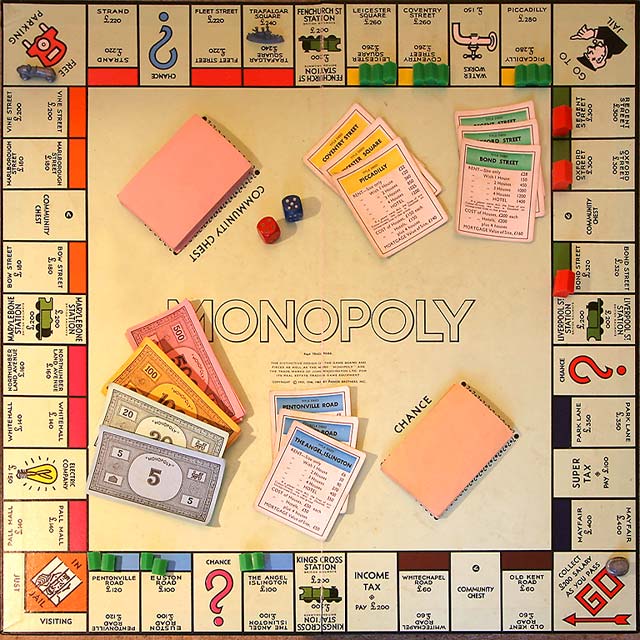
Unless you had a sadly deprived childhood, you have probably played Monopoly. In Australia in the 1980's, everyone had a set that looked like the one above with street names from London, but with prices listed in $ instead of £. So strange. Even the McDonald's Monopoly promotion in Australia used the UK version's property names. I thought the game was actually from the UK and that those names were original until I moved to America and was laughed at by my husband.

Monopoly is phenomenally successful for good reason. It demonstrates to players how fun capitalism can be, and how much power money wields. It's especially gratifying for children, who have zero financial autonomy, because for a little while they can feel like they imagine their parents do, collecting money and refusing to give it out unless required.

But wait. Funny thing: even though the game is called Monopoly and the simplest objective for players is to obtain a monopoly, the original point of the game is to teach us the negative effects of monopolization.

I have to assume that a lot of Americans (to pick on one group) didn't have the patience to play the game through to the end, otherwise they would probably understand that point. Not so in my family. We didn't play Monopoly all that often, because my mother and I were so stubborn, it would take hours to complete. How does a Monopoly game end? First, there have to be only two players left, because everyone else has gone bankrupt and had to retire. At this point, the game becomes an extremely boring and joyless death match. Everyone who bowed out has left the room to do something else. The two remaining players pay money to each other, back and forth, until eventually one of them, through dumb luck, ends up owing more to the other player than they own.

The last player, having achieved a true monopoly, is the winner, and the game ends.

The game ends. Nobody can play anymore. The bank closes, and the properties go to waste because nobody can pay rent. The winner is left with a pile of fake money, and because everyone else has already gone home, they have to pack up the board and wallow in their own miserable loneliness.

If you don't have the attention span to play the game through to the end, capitalism is about getting as much money as you can and fucking over as many other people as possible, because this is rather fun.

If you do play the game through to the end, you realize that once you've won, the entire system falls to pieces because nobody else can play, and having a monopoly and too much money is ridiculous and sad, because once you win, everything you've won is worthless.

At some point, if you play Monopoly enough, you discover that the only way to keep the game fun is to make sure other players stay in the game by trying not to exploit them too much. Sometimes we would bend the rules in my family. We would make alliances and loan or give money to each other to keep each other from going bankrupt. We would forgive rent, or pay more than a property was worth to help players that were struggling. This also usually prevents other players from all hating the winner, should the game be played through to the end.

That is the lesson of Monopoly. And apparently a lot of people in this country didn't have the mental discipline to learn it.