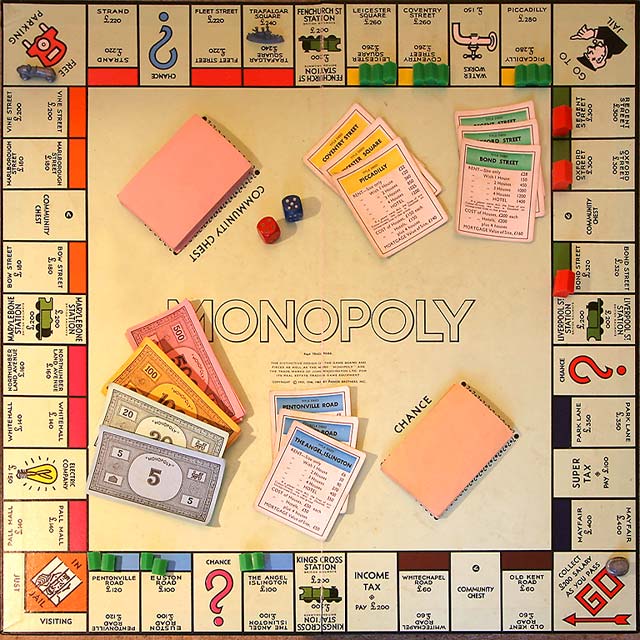
Unless you had a sadly deprived childhood, you have probably played Monopoly. In Australia in the 1980's, everyone had a set that looked like the one above with
street names from London, but with prices listed in $ instead of £. So strange. Even the McDonald's Monopoly promotion in Australia used the UK version's property names. I thought the game was actually from the UK and that those names were original until I moved to America and was laughed at by my husband.
Monopoly is phenomenally successful for good reason. It demonstrates to players how fun capitalism can be, and how much power money wields. It's especially gratifying for children, who have zero financial autonomy, because for a little while they can feel like they imagine their parents do, collecting money and refusing to give it out unless required.
But wait. Funny thing: even though the game is called Monopoly and the simplest objective for players is to obtain a monopoly, the original point of the game is to
teach us the negative effects of monopolization.
I have to assume that a lot of Americans (to pick on one group) didn't have the patience to play the game through to the end, otherwise they would probably understand that point. Not so in my family. We didn't play Monopoly all that often, because my mother and I were so stubborn, it would take hours to complete. How does a Monopoly game end? First, there have to be only two players left, because everyone else has gone bankrupt and had to retire. At this point, the game becomes an extremely boring and joyless death match. Everyone who bowed out has left the room to do something else. The two remaining players pay money to each other, back and forth, until eventually one of them, through dumb luck, ends up owing more to the other player than they own.
The last player, having achieved a true monopoly, is the winner, and the game ends.
The game
ends. Nobody can play anymore. The bank closes, and the properties go to waste because nobody can pay rent. The winner is left with a pile of fake money, and because everyone else has already gone home, they have to pack up the board and wallow in their own miserable loneliness.
If you don't have the attention span to play the game through to the end, capitalism is about getting as much money as you can and fucking over as many other people as possible, because this is rather fun.
If you do play the game through to the end, you realize that once you've won, the entire system falls to pieces because nobody else can play, and having a monopoly and too much money is ridiculous and sad, because once you win,
everything you've won is worthless.
At some point, if you play Monopoly enough, you discover that the only way to keep the game fun is to make sure other players stay in the game by trying not to exploit them too much. Sometimes we would bend the rules in my family. We would make alliances and loan or give money to each other to keep each other from going bankrupt. We would forgive rent, or pay more than a property was worth to help players that were struggling. This also usually prevents other players from all hating the winner, should the game be played through to the end.
That is the lesson of Monopoly. And apparently a lot of people in this country didn't have the mental discipline to learn it.