
Sunday, March 10, 2013

Eat, Compose, Love

Bless me, Blogger, for I have sinned. It has been two months since my last entry.

Right this instant I am exhausted.

At long last, for about a month now, I have had only one project on my plate: Ayn. I have been on this earth for nearly 33 years, and this singularity of purpose is unprecedented. But for some stupid reason, I feel more tired for it. Perhaps, with less noise, I am able to feel the accumulated weariness for the first time. In any case, I'm making progress on the opera — slow progress, but progress nevertheless — but when the notes come out sounding like garbage because my brain has run out of juice for the day, I find myself totally confused and lost by the lack of other items on my to-do list. I pace around mindlessly like a broken Roomba. I don't think I've ever dealt with feeling like this before. It's an experiment.

A couple of old projects have managed to demand my attention recently, however. The most notable news is that Tesla's Pigeon will be performed in New York City next month, thanks to this wildly successful ongoing kickstarter campaign I launched ten days ago:


It's a little overwhelming to receive so much support from friends near and far — and even a few total strangers. And since the campaign also introduces my current project publicly, the pressure is on for Ayn. I have expectations to fulfill, theirs and mine.

Meanwhile, the Tesla's Pigeon concert will be at 7:30PM on April 22 at Christ & Saint Stephens Church. I'll post more about it closer to the date.

Then, exactly a week later, Jess and the Curtis Symphony will record my orchestration of Tesla's Pigeon, which I was feverishly arranging when I wrote my last blog entry. I'm pretty excited to hear it played, even if it does create some non-Ayn noise in my head. I spent rather too much time in January learning how to bind books so I could make a hardcover score, which kicks some serious arse over the spiral binding that is the standard:
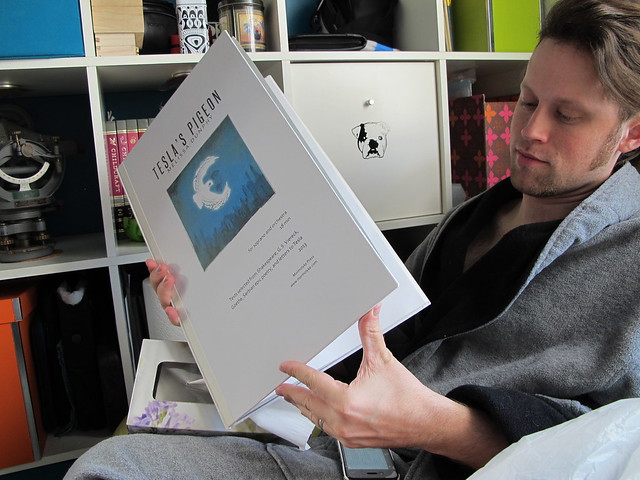
Matt (with the flu) opens my very first hardcover bound score - Tesla's Pigeon for soprano and orchestra

^^ These are also available as a reward on the Kickstarter campaign.

This afternoon, the Kennett Symphony Orchestra and Children's Chorus will give the second of two children's concerts featuring my brand spanking new revision of Jack and the Beanstalk at my alma mater West Chester University; last summer, I tore into the first edition, ripped out and abridged some movements, interpolated some new songs (including the most ridiculously catchy number I've ever written in my life, "These Beans"), added some lyrics to existing instrumental melodies, and rearranged the whole thing for chamber orchestra. It's shorter, but I think it's way better. Judging from the post-performance reactions last week, the kids seem to enjoy it, which is about the best compliment a composer can get; kids that young are unabashedly honest, and they're difficult to fool. Of course, everyone is nuts over "These Beans," but unfortunately, I can't let you hear a recording because of the stipulations of the Musician's Union. I might have some choice words on that matter in a later post.

Captain Samuels Speaks to the Sea! made its UK debut in February at the Two Rivers Festival, the first time any piece of mine has been performed over the pond as far as I know. I am surprisingly proud of that piece. I started listening to it the other day and found myself quite liking it, and I played it all the way through, good heavens. I know that sounds a bit batty, but I don't do much playback of my finished pieces because I start to pick at them and want to change them, and I'd rather write new stuff.


On a non-musical note, last month Matt and I got the results of our DNA test from 23andMe. If you have $99 to spare, I highly recommend it; fascinating stuff, especially for someone like me descended from immigrants who tend to leave the past behind and have no interest in genealogy. As far as recent ethnic background is concerned, I didn't find out anything I didn't already know: my mother is a Chinese as they come, and my father is as Greek as they come. The only surprise was 2% Italian heritage on my father's side, which really isn't all that surprising at all. Of more interest is the data from further back: I have 3.1% Neanderthal DNA, which puts me in the 98th percentile. I thought this was pretty badass until Matt looked at his DNA profile: he has 3.2% Neanderthal DNA, placing him in the 99th percentile. That's about as close as we come to being related.

Sunday, January 06, 2013

Orchestrating Tesla's Pigeon, Part 2

I took the day off today. Matt and I ran errands and visited Philly Electric Wheels to try out one of their new electric bikes I've been eyeing up to replace my old clunky 68-pound eZip*. I would like to get back into commuting on two wheels (hopefully without being physically attacked or hit by a car) because I am quite possibly the most unfit able-bodied person on the planet. Like, I test-rode the bike -- an electric pedal assist bike -- for maybe two blocks and back, and now my quads hurt. What.

This week has reminded me why I procrastinate so heavily before working on a composition. It takes over everything. I lost five pounds in five days because I forgot to eat and my brain was burning fuel overtime. I forgot how to interact with people. I slept poorly, woke early, and went straight from my bed to my office like a zombie. I neglected my husband. I let some of my plants die. I didn't do any housework.

Instead, I threw together a 55-page orchestral score. Thank god for Sibelius keyboard shortcuts; even as good as I am with them, the wrist on my mouse hand is sore. Yesterday I tried to take a break. Do something else! my body screamed at me. You cannot sustain this level of focus! What I ended up doing was cutting some 100lb paper to 10 by 13 inches in order to eventually print parts on them, and after about an hour of guillotining, I went back to working on the score.

Today I finally tore myself away, and now I don't want to go back for a while. But I'm seeing my teacher on Thursday, so I'm sure that will suck me back in to endless tweaking and formatting, and I'll have ECU tendonitis before you know it.

Speaking of Tesla, tomorrow I have to get up at the crack of dawn and drive myself and my long-suffering husband to the New Yorker Hotel in Manhattan for the inaugural Tesla Memorial Conference. Tesla's star sure is on the rise, and it's neat that I'm apparently a part of that. I'm giving a short talk at the 5:00PM session, but I'll be hanging around all day. Hey, maybe they'll let me go in his old room.

Oh, by the way, there are some moments in the orchestration which I am REALLY REALLY happy about. The Wagnerian harmonies in song VII are going to sound so freaking boss on brass, and song VI was basically written for harp; I barely had to make any adjustments (although those adjustments took forever, because I had to remember how harp pedaling works).

Of course, the *real* reason I'm working this hard is because I'm procrastinating Ayn. Sigh.

* The Fast4Ward Edge, if you're interested. This would be the most expensive bike I've ever owned by a factor of 5.

Thursday, January 03, 2013

Orchestrating Tesla's Pigeon

I've been talking idly about arranging Tesla's Pigeon for orchestra for a long time. Ever since writing it, I've clearly known which instruments are supposed to be playing each line. Maybe this has something to do with what a crap pianist I am; even when I'm writing for piano, I'm not really writing for piano.

Anyway, I started by sitting down this weekend with this awesome score of the Ravel orchestration of Mussorgsky's Pictures at an Exhibition that I found in my room. I have no idea how it got there -- did someone give it to me? Did I buy it one day knowing I'd need it? At any rate, I pulled it out along with the piano score, only to discover that BY GOD these Eulenburg geniuses have included the original piano in the orchestral score for reference. Modern convenience. So great. Thank you, whatever unseen force put this score on my shelf.

The solstice is past, and I can feel my body and brain slowly turning toward the spring and seeing light at the end of a seasonally depressed tunnel. It's been a nasty slump this winter. The one "good" thing about depression is that it sometimes precipitates very intense emotional reactions -- to music, for example. So long as I'm not out in public or trying to drive straight, I appreciate them. I listened to Pictures at an Exhibition by myself with my handy Eulenburg Edition score on Sunday, and by the time I walked past the Great Gate of Kiev, I had completely lost it. I was literally sobbing. Sobbing! I mean, sure, I love that piece. I played it with QYO back in the day, and most of the pieces I played in my mid-teens made a huge impression. But: heaving sobs ... I haven't had that happen during a piece since I accidentally caught the Alpine Symphony on NPR back in 2008. Funnily enough, I played that with QYO too. Probably something to be said about that.

God, Ravel is good.

My hope is that I will have it orchestrated by the time school starts next week, and that the Curtis Orchestra will read it this semester. With Jess Lennick on pipes, naturally. I've made a cracking start: all the main stuff has been parceled out to the appropriate instruments, and now I just have to embroider. Oh, and create parts, I guess. Ugh.

I am heading to bed with this Eulenberg score. It's even a convenient bed-reading size. Such a fan.

Thursday, October 04, 2012

Elegy for a Soprano

As you can probably tell, I've been doing an awful lot of Ayn reading these past few weeks; I realized there are some slippery things about the material and the dialogue and the characters' voices that I need to get a handle on before I can continue with the opera.

One of the books I whipped through was The Ayn Rand Cult, which was a fun read (even if there were a few weird misspellings like "Dagney" and some stretchy conclusions and assumptions):


I can't seem to definitively find Jeff Walker, a Canadian journalist, on an online social medium where I can casually interact with him, which is a surprising and a little disappointing, because if nothing else, I want to thank him for alerting me to the existence of Kay Nolte Smith's novel Elegy for a Soprano, which I cannot believe I didn't know about until now. That will teach me to stick to the non-fiction shelves.


Blurb:
THE DEATH OF A DIVA
Dinah Mitchell is saddened when she learns her favorite opera star, Vardis Wolf, has been poisoned - especially when she discovers that the woman behind the beautiful voice was her natural mother. Dinah journeys into the dark world of genius, driven to find out the truth about the singer's life ... and death.

Why is this so exciting? I hear you ask.
From the wiki of the author, Kay Nolte Smith:
She was for a time friendly with the philosopher-novelist Ayn Rand, who was her leading literary and philosophical influence... Smith launched her literary career after her separation from the Ayn Rand circle... Her novel Elegy for a Soprano is a roman a clef inspired by Rand, Nathaniel Branden, and the circle around them.

OH SHIT WHAT.

So I bought the book on Amazon, and I hardly dared to hope, but YES YES YES the stand in for Ayn Rand is the eponymous soprano! OMG SO PERFECT! She's like Rand crossed with Callas. As the wiki suggests, other lead characters including a very obviously drawn pseudo-Frank, pseudo-Nathaniel, and pseudo-Barbara, and a possible pseudo-Leonard.

AND HOLY SHIT the novel opens with Vardis/Ayn singing Salome, and of course the whole story is soaked in opera. So freaking perfect. It's also an easy-reading page-turner, especially for someone like me who has a thing for mystery novels, and it takes an unexpectedly moving left turn into the Holocaust at the end.

In case you couldn't tell, my Ayn is also a soprano. I feel quite validated that someone who actually knew her would also portray her as a soprano in pseudo-fiction.

Monday, October 01, 2012

What the hell kind of music does Richard Halley write, anyway?

Last week I read Atlas Shrugged, and I have so, so many things to say (or rather "scream" as EVERYONE IN THE BOOK DOES, CONSTANTLY) about so, so many things, but as a composer, I wanted to point this one out in particular.

There is, remarkably, a composer woven into the narrative named Richard Halley. Although we don't know the exact nature of his music, it is evidently so wonderful and heroic that a mere melody written by him, whistled by a stranger completely without context, transports hero industrialists into ecstasies of delight that cause them to extrapolate an entire orchestration in their imagination. No, really, that happens.

Later, we get to meet Richard Halley, who has withdrawn completely from the world and is hiding out in Galt's Gulch, much to the delight of fangirl Dagny. He furnishes her and us with an explanation for his disappearance (see below for TL;DR, because omg writing):
"I would have forgiven men for my struggle," said Richard Halley. "It was their view of my success that I could not forgive. I had felt no hatred in all the years when they rejected me. If my work was new, I had to give them time to learn, if I took pride in being first to break a trail to a height of my own, I had no right to complain if others were slow to follow. That was what I had told myself through all those years —except on some nights, when I could neither wait nor believe any longer, when I cried 'why?' but found no answer. Then, on the night when they chose to cheer me, I stood before them on the stage of a theater, thinking that this was the moment I had struggled to reach, wishing to feel it, but feeling nothing. I was seeing all the other nights behind me, hearing the 'why?' which still had no answer—and their cheers seemed as empty as their snubs. If they had said, 'Sorry to be so late, thank you for waiting'—I would have asked for nothing else and they could have had anything I had to give them. But what I saw in their faces, and in the way they spoke when they crowded to praise me, was the thing I had heard being preached to artists—only I had never believed that anyone human could mean it. They seemed to say that they owed me nothing, that their deafness had provided me with a moral goal, that it had been my duty to struggle, to suffer, to bear—for their sake—whatever sneers, contempt, injustice, torture they chose to inflict upon me, to bear it in order to teach them to enjoy my work, that this was their rightful due and my proper purpose. And then I understood the nature of the looter-in-spirit, a thing I had never been able to conceive. I saw them reaching into my soul, just as they reach into Mulligan's pocket, reaching to expropriate the value of my person, just as they reach to expropriate his wealth—I saw the impertinent malice of mediocrity boastfully holding up its own emptiness as an abyss to be filled by the bodies of its betters—I saw them seeking, just as they seek to feed on Mulligan's money, to feed on those hours when I wrote my music and on that which made me write it, seeking to gnaw their way to self-esteem by extorting from me the admission that they were the goal of my music, so that precisely by reason of my achievement, it would not be they who'd acknowledge my value, but I who would bow to theirs. . . . It was that night that I took the oath never to let them hear another note of mine.

(TL;DR I suffered for a long time because my music was so innovative that nobody liked it. Then one day, I achieved acclaim with one of my pieces. But while they were cheering, the audience didn't once apologize for not liking my music before! Instead they acted like it was my job to teach them how to enjoy my music! They thought I was writing my music for them! Those looters! I will never let them hear my music again!)

Well! Let's put aside what I might think of this attitude for a moment, because I am clearly an immoral moocher-lover. Given that Ayn was writing this in the 1940's and 1950's, one might assume that she is portraying a composer of modern music, right? It makes sense. I mean, if anyone could be accused of writing music that audiences had to be taught to enjoy, it would be the Second Viennese School (and I think it could be argued that audiences still haven't learned to appreciate them). And "Who Cares If [They] Listen" anyway. So in my head, Halley was a mighty expressionist. Let's hear a hearty cheer from the atonalists out there! Ayn Rand, for all her faults, is championing your music and your struggle!

You can guess where this is going.

What's this? From the book What Art Is: The Esthetic Theory of Ayn Rand (good lord):
A brief word about so-called modern music: no further research or scientific discoveries are required to know with full, objective certainty that it is not music. The proof lies in the fact that music is the product of periodic vibrations -- and therefore, the introduction of nonperiodic variations (such as the sounds of street traffic or of machine gears or of coughs and sneezes), i.e., of noise, into an allegedly musical composition eliminates it automatically from the realm of art and of consideration. But a word of warning in regard to the vocabulary of the perpetrators of such "innovation" is in order: they spout a great deal about the necessity of "conditioning" your ear to an appreciation of their "music." Their notion of conditioning is unlimited by reality and by the law of identity; man, in their view, is infinitely conditionable. But, in fact, you can condition a human ear to different types of music (it is not the ear, but the mind that you have to condition in such cases); you cannot condition it to hear noise as if it were music; it is not personal training or social conventions that make it impossible, but physiological nature, the identity, of the human ear and brain.

WOMP WOMP.

I find this deeply hilarious.


Thursday, September 13, 2012

Paying musicians: a modified Facebook rant.

New York Times : Rockers Playing for Beer: Fair Play?

I've been behind Amanda Palmer on a lot of things, but I don't agree with her here.

I'm not saying this as a sad-sack loser musician whining for more money or someone pathetically jealous of her success. Performing for others hasn't been a big part of my musical existence for years. I was (am) fully behind her amazing Kickstarter and everything that she has done to advance the post-label model of music business.

No, I'm saying this as someone who hires musicians to perform my music.
I'm saying this as, if you like, a "job creator."
I may not be Amanda Palmer's equal, career-wise, but I'm in something of the same role as her in this situation.

I always try to make a point of paying musicians whom I ask to play my music. If I can't afford it, I don't ask. I do this despite the fact that I'm not high profile, and I'm certainly not wealthy.

I've done some recordings. I've put on a couple shows. I may not pay my musicians a helluva lot, but I consider it a moral choice for me to pay them whatever I can, and I've done that right from the beginning. I will pay them out of my credit card and personal savings if I have to, hoping that I'll at least make my money back (and thankfully, so far, I have been able to do that). I paid myself way, way less than minimum wage out of the Gonzales Cantata takings - even though I was composer, director, producer, promoter, and conductor - so I could cut all thirty of my performing musicians three-figure checks for singing in three shows. As some of them have attested, many of them wouldn't have cared if I didn't pay them, accepting the catered lunches we provided and the spot on Rachel Maddow as compensation enough (and, hopefully, the fun of playing my music). They would have played for free. But I won't let them. That's a moral choice for me.

"Isn't it the choice of the musician whether they want to play for beer or not?"

Actually, no: it is the choice of the person hiring the musician whether they want to pay them or not, and I think it's pretty clear that this is the moral choice to which I am referring.

Here's what I saw when I lived in Sydney (I moved to the USA in 2003). When electronic music became a big thing in the 90's, lots of clubs and bars discovered that it was cheaper to pay a DJ for the night than to pay a live band or three. So many clubs became DJ-only that there were only a few venues left willing to host live bands. Gradually, they began paying the bands less and less to play. Then most of them said, fuck it, there are so many bands that will play for free now, we won't pay any bands. The bands should feel grateful that they get to play at all, right? If a band demanded payment, the venue would shrug and instead hire a band that would play for free. Some venues started charging bands to play. You had to fucking pay to play. This was the status quo, and there were no real alternatives.

The end result of this? A lot of bands and musicians couldn't afford to be active any more. And the only people who were active were the people who could afford to play for free. In other words, you could afford to be in a working band if and only if you were already socioeconomically privileged.

Music is already an expensive enterprise. You have to buy expensive equipment. If you want to be able to actually play your instrument, you need expensive training. You need to have ample spare time to practice, alone or with other people. It's a far more rigorous and expensive discipline than acting, for example, and I say this as someone who has done a lot of theater. There's already enough of a barrier to people with no money getting into music. As someone who is in a position to hire musicians, I will not be party to the kind of exploitation that perpetuates this situation. I will not say to a worker: well, it was your choice to accept this shitty pay job, and you'd better like it, or you can fuck off, because otherwise I'll just find some wealthier musician out there that can afford to earn peanuts. And by peanuts, I mean nothing. And by nothing, I mean you're actually making a loss because you paid for gas.

And before anyone goes talking to me about supply and demand and what the free market can bear: no, fuck you. Just because it was possible during the Industrial Revolution to pay children practically nothing to work in awful environments that frequently led to their deaths, it isn't right. Just because supply and demand make it possible to have thousands of sweatshop workers in Asia living as indentured servants who will never be able to make a better life for themselves in order that Americans can buy cheap clothes and electronics, it isn't right. Just because colleges can get away with increasingly only hiring instructors part time so they can never give them any kind of benefits or job security, it isn't right. Oh, but all those people wanted to work! They were so much better off than they would be without the job! In the case of adjunct professors, they may even love their job because they have a calling to education! No. It's still. Not. Right. This is a moral choice for me. This is a philosophical choice. And I don't agree with the moral/philosophical choice Amanda has made here, perhaps unwittingly. She paid all the visual artists, even though I'm sure many of them would have done the work for free. That's admirable. Why shouldn't professional musicians get the same treatment?

Here's the saddest part of it for me: saying that everything is above board when you don't properly compensate musicians because they LOVE to play and LOVE their boss and LOVE the exposure and CHOSE their own path ... I have heard these exact, I mean these *EXACT* words directly from representatives of the predatory record labels that Amanda excoriates, justifying their treatment of musicians they've signed. I understand that this was not some evil malicious plan on Amanda Palmer's part. The problem is systemic, and for all the amazing things that she has done, I understand that it's hard to completely leave behind an entrenched system, with all its entrenched exploitative problems.

But, at least in my view, we have a moral obligation to make things better if we can. And if I can, I'm pretty sure she can too.

Thursday, July 26, 2012

Everything I needed to know about capitalism, I learned playing Monopoly


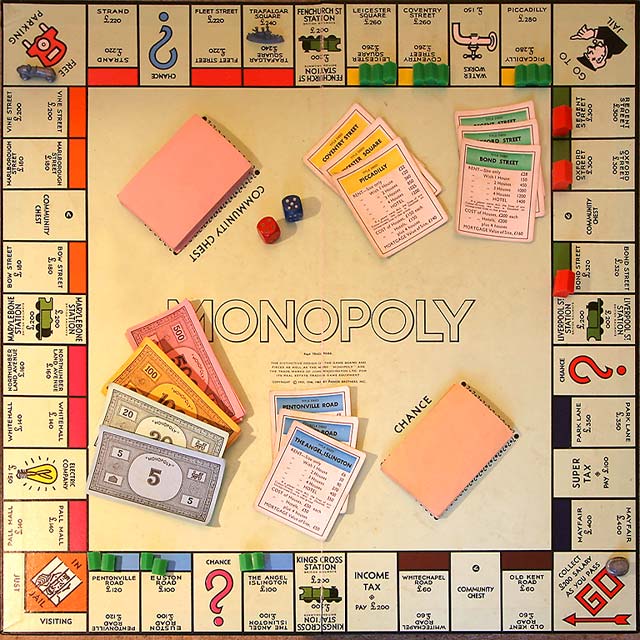
Unless you had a sadly deprived childhood, you have probably played Monopoly. In Australia in the 1980's, everyone had a set that looked like the one above with street names from London, but with prices listed in $ instead of £. So strange. Even the McDonald's Monopoly promotion in Australia used the UK version's property names. I thought the game was actually from the UK and that those names were original until I moved to America and was laughed at by my husband.

Monopoly is phenomenally successful for good reason. It demonstrates to players how fun capitalism can be, and how much power money wields. It's especially gratifying for children, who have zero financial autonomy, because for a little while they can feel like they imagine their parents do, collecting money and refusing to give it out unless required.

But wait. Funny thing: even though the game is called Monopoly and the simplest objective for players is to obtain a monopoly, the original point of the game is to teach us the negative effects of monopolization.

I have to assume that a lot of Americans (to pick on one group) didn't have the patience to play the game through to the end, otherwise they would probably understand that point. Not so in my family. We didn't play Monopoly all that often, because my mother and I were so stubborn, it would take hours to complete. How does a Monopoly game end? First, there have to be only two players left, because everyone else has gone bankrupt and had to retire. At this point, the game becomes an extremely boring and joyless death match. Everyone who bowed out has left the room to do something else. The two remaining players pay money to each other, back and forth, until eventually one of them, through dumb luck, ends up owing more to the other player than they own.

The last player, having achieved a true monopoly, is the winner, and the game ends.

The game ends. Nobody can play anymore. The bank closes, and the properties go to waste because nobody can pay rent. The winner is left with a pile of fake money, and because everyone else has already gone home, they have to pack up the board and wallow in their own miserable loneliness.

If you don't have the attention span to play the game through to the end, capitalism is about getting as much money as you can and fucking over as many other people as possible, because this is rather fun.

If you do play the game through to the end, you realize that once you've won, the entire system falls to pieces because nobody else can play, and having a monopoly and too much money is ridiculous and sad, because once you win, everything you've won is worthless.

At some point, if you play Monopoly enough, you discover that the only way to keep the game fun is to make sure other players stay in the game by trying not to exploit them too much. Sometimes we would bend the rules in my family. We would make alliances and loan or give money to each other to keep each other from going bankrupt. We would forgive rent, or pay more than a property was worth to help players that were struggling. This also usually prevents other players from all hating the winner, should the game be played through to the end.

That is the lesson of Monopoly. And apparently a lot of people in this country didn't have the mental discipline to learn it.

Sunday, July 15, 2012

Up Your Cherry - we made a song

Finally, when someone asks me what Up Your Cherry sounds like, and whether we have any recordings, I can point them toward something. We just finished mixing and uploading our first song, "This One."


Yes, it's in 7/4 mostly. Of course.

We have at least one more song to record this week, and we're also hoping to revamp the website. I've also been tossing around video ideas with a friend of ours Chris Braak, who will hopefully also be joining us live at some point in the not-too-distant future on bass.

In the meantime, this coming Saturday July 21, we have a gig to play, the first we've had time to book in ages. We're the house band for a puppet slam at Walking Fish Theater for the second time. It's hella fun, and you should go. Here's a flyer:


Tuesday, July 03, 2012

NATS 52nd National Conference -- a weekend in Orlando -- also, SeaWorld and DINOSAURS

As previously reported, this past weekend, Matt and I went to Orlando for the NATS National Conference, where Tesla's Pigeon, which won the Art Song Award Competition, was performed on Saturday. We had a terrific time, and I hope I manage to stay in touch with the many wonderful people we met. I couldn't possibly list all of them, but of special note are Carol Mikkelson, the NATS Art Song Coordinator, who is quite possibly one of the sweetest people I think I've ever met, with one of those gentle southern accents I could listen to all day, and Colleen Gray (soprano) and Nanette Kaplan Solomon (pianist), who together performed Tesla's Pigeon. In addition to being lots of fun, they are both quite extraordinary and dramatic musicians who learned the work in record time despite being busy with so many other things. They sold the hell out of my songs in the concert!


Carol feeds me a cookie.


Introducing Tesla's Pigeon at the NATS Convention

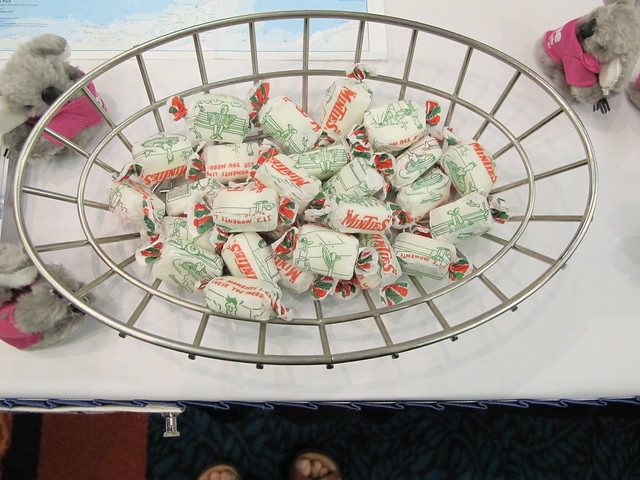
On Saturday morning, I was browsing the booths in the exhibit hall, when I spotted an Australian flag out of the corner of my eye. What's that about? As I drew in closer, I saw a table was stacked with all manner of tourism information for Brisbane. Brisbane!? The city in which I was born and bred? Eh? I was so absorbed in trying to figure out why my hometown had its own booth at NATS, I completely missed the basket of lollies to one side. "Mel," asked Matt, "is this Australian candy--?"

MINTIES!!
MINTIIIIIES!!!!

MINTIES!!! I got very excited about these at the ICVT table #nats52

I'm not sure I've ever been so excited about Minties in my life. I hadn't even thought about them in nearly a decade. For confused Americans: Minties are functionally equivalent to Tootsie Rolls, but white and mint-flavored (and Australian, obviously).

It turns out that beloved BrizVegas is the host city for the 2013 International Congress of Voice Teachers next July, and in attendance at NATS were representatives from the Australian Voice Association. I didn't get to properly sit down with them all, but I met the president Jane Mott and had the chance to speak with VP Adele Nisbet, and caught a good case of homesickness talking about mutual friends and haunts. They left me with a bunch of Minties (eating the last one now) and a packet of Aussie flag cocktail toothpicks (expect those to show up at future house parties).

The conference was held at the Renaissance Hotel at SeaWorld, so it seemed natural Matt and I should hang out at SeaWorld on Sunday, especially with discounted tickets. I enjoyed myself more than anticipated, and didn't even mind the Florida heat (Philadelphia was simultaneously in the grips of a heatwave that brought worse temperatures anyway). I sort of forgot that SeaWorld is more circus than zoo or amusement park -- and the animals actually do seem to enjoy performing, although I'm sure PETA would disagree or something. They even have one of those troupes of rescued pets that seem to be all the rage at the moment, which of course turned Matt and I into insufferable cat idiots squeeing at all the performing kitties.

The biggest squee of Sunday, however, was reserved for a blog comment notification that buzzed my phone in the middle of the seal and sea otter pirate show. One of the highlights of our recent roadtrop was a dinosaur dig we did in Wyoming, and our guide dropped into the roadtrop blog to give us some exciting news about a bone I found at the dig -- see the latest roadtrop entry for details!


Now we're back in Philly. I have parts to create for a new arrangement of Jack and the Beanstalk for the Kennett Symphony, and a crapload of laundry to fold. Sigh.

Wednesday, June 27, 2012

in a composition hole don't try to talk to me

I'm trying to wrest myself away from an arrangement I'm doing of one of my pieces. The reason I'm always putting off composing is that when I start, it takes up everything. All my physical space, all my mental space, all my energy ... I forget to eat and sleep, I don't want to talk to anyone, and even when I'm forced to pull back (as I'm forcing myself to now, for my own health), all I can really think about is how I need to get this composition finished.

You know what? I don't care how bad MIDI instruments sound (and WOW have they come a long way since I ditched writing music on paper 16 years ago), I freaking love playback. No amount of sneering from composers who think we young 'uns rely too much on it will counteract the inherent coolness of being able to say, "Hey, slave robot orchestra inside my computer, now play this! Wait, now try THIS!"

Yeah, I guess I could still compose without playback, but I'm really bad at remembering to put in accidentals, probably because I grew up singing fixed do. And besides, the less pressure I put on my underslept malnourished brain, the longer I can go without sleeping or eating. Win-win.